
Oh, how I would love to offer something salacious to justify the outrageous title. If I had the forethought, I should be writing an episodic daytime drama that captures the emotion and mystique of community pharmacy.
Just think: the excitement of finding a favorite pen that a colleague had been hoarding, the heartbreak of losing a customer who had developed into a close friend, and the passive-aggressive dance to decide whose turn to grab the cash. In 15 years, I never seem to run out of stories to tell, although on second thought, most are the ‘you had to be there’ variety.
After a stressful week, I am left to ponder the sobering realities of my chosen profession. One question in particular comes to mind:
How do I keep my lab coat white?
A quick reference check from the most trusted website on all of the internets, Wikipedia, tells us that lab coats were introduced to the medical profession in the late 1800’s to denote cleanliness. I admit, it’s very easy to tell if the lab coat gets grungy, especially around the cuffs from resting on dusty, drug residue-covered counters, or having a collection of pen-stripes above the pockets when you forget to retract the tip.
The symbol has evolved to portray trust and knowledge. To wit:
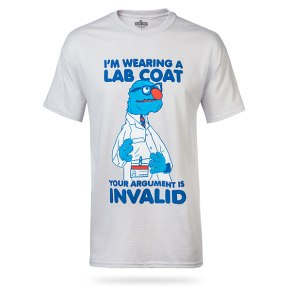
Image courtesy of our friends at Thinkgeek.com:
http://www.thinkgeek.com/images/products/zoom/18ed_grovers_lab_coat.jpg
Though we are far from infallible, we are trained to make judgement calls and defend our decision-making processes. This may be intimidating for many members of the public; previous generations would never dare challenge their family physician and lived in fear of disappointing them. White-coat hypertension is a very real phenomenon for many patients wary of the unknown, who build up stress in advance of an appointment, akin to waiting outside the principal’s office or prepping for a job interview.
Lab coats can be a bit on the controversial side as well. Many in professional settings eschew wearing an extra, often hot and uncomfortable layer. There is also growing concern of cross-contamination with super-bugs like methicillin-resistant Staphylococcus aureus (MRSA). There’s also the practicality argument: lab coats used in laboratory settings protect the wearer from chemical spillage on their clothes or skin. Generations ago, when most medicines were compounded, this may have been a solid stance, but then again smoking in the dispensary was also acceptable too.
My personal take? Over the years I’ve softened on the need for a white coat. As students taking pharmacy degrees or technician certification discover in their first years of study, receiving a white coat welcomes you into a strong, trusted community. I’ve always worn one, and feel pride when I interact with patients, colleagues and other professionals. The analytical side of me identifies with the science and the constant drive for higher knowledge. That said, I don’t question another professional’s preference to avoid wearing one unless it’s part of a uniform outlined by an employer or educational institution. Pharmacists find themselves in so many collaborative settings nowadays, be it committee-work, nursing homes, regulatory, administrative roles, etc. that are founded on relationships and trust that go much deeper than a symbolic white coat. In public forums, there’s no mistake that a lab coat will certainly draw attention and identify the wearer as someone who more than likely comes from a scientific or healthcare-related background (just ask any pharmacist in a grocery-store setting running to the deli for a quick lunch break).
So my point is: anyone have a recommendation on a good bleach?
Disclaimer: The views and opinions expressed in this article are those of the author(s) and do not necessarily reflect the official policy or position of any agency, employer or affiliation.

 PharmAspire
