Resolution Follow-up

For the first time ever, I have accompanied my morning coffee with an ample bowl of Lucky Charms. Hey, when you’re on the go you need to eat some kind of breakfast in the morning. If you can’t get excited about sugary marshmallows with the consistency of dense styrofoam floating in your cereal, then I guess that makes you older than six. It just so happens to be the perfect combo of sugar and caffeine to get the writing juices flowing.

It’s a bit overdue, but with the new school year upon us it seems like a good time to revisit my New Years Resolution Post. Eight months is a good yardstick to see if I’m making progress, albeit a completely arbitrary mid-point.

So first off: gym. I’ve been steady at getting there twice a week between shift-work and evenings at home with the kids. Sometimes it’s not the most energetic session, but my cardio is decent and remains fairly stable.

#2) Guitar – Ah yes, my muse. ‘I know chords’ is a sure fire way to let people know you own a guitar and mess around with it on occasion. A small update on that front: since January, a few friends and I have started a garage cover band and I’ve discovered the bass. So to anyone who is interested in how that’s going, ‘I know chords’.

#3) Getting the house in order – There is always stuff to do around the house. By my standards, I’ve been rather slack. My father and I were successful at tearing down the rotten deck on the back of the house. Landscapers have since put in a french drain and flagstone patio. I’ll take that as a win.

Finally, the practice resolutions:

#4) Letting go – I couldn’t be more proud of how my team has developed over the past year, both in cohesiveness and as a visible presence in the grocery store where we work. I made a key hire in November 2013 for an assistant supervisor and even though I had high expectations, she is well on her way to exceeding most of them in less than a year. This has allowed me to delegate many of my dispensary manager duties. Functions including evaluating and hiring assistants, payroll, accounts receivable, team communication, scheduling, budget reviews, and department meetings are all shared between us. I’ve had more time to focus on promotion, special projects, succession planning, and most importantly spending the time I need with patients (occasionally I get an idea for writing as well). It has been a pleasure to watch her grow into the role and flourish.

5) Inviting a prolonged patient interaction – believe it or not, this is still not as instinctive as I once thought. We still have daily pressures that can make conditions for such an interaction difficult. That said, my relationship with many of our patients gets stronger every day. I enjoy seeing them visit and they will ask for me. I recently had an extremely positive interaction with a patient frustrated with his diabetes control. The doctor appreciated my recommendations and now we have a baseline from which to work. Another gentleman with chronic pain shook my hand the other day to thank me for ‘being good to (him)’. One more off the top of my head is a man who underwent surgery for cancer and is doing well. Through a miscommunication with his wife, they accidentally transferred out, then immediately transferred back and apologized profusely.

Overall, have I met my targets? Not all of them, but I’m not beating myself up over it. There are so many positives I can point to that make the exercise worthwhile. We’re positioned better than ever to provide injections through the flu season, we’re providing medication review services to a larger number of patients, and my team is still growing and improving. The biggest winner in all of this is me; they make me better, and I resolve to ride this wave as long as I can.


Disclaimer: The views and opinions expressed in this article are those of the author(s) and do not necessarily reflect the official policy or position of any agency, employer or affiliation.
The Payback of a Little Charity

A couple weekends ago I hopped on my bike and pedaled close to 100 km in my 4th MS Bike Tour.

The distance is one thing, and the need for a good pair of padded undergarments always provides ample fodder for tour volunteers and non-riding supporters. This year turned out to be one of the best yet, though very different than my previous three. This difference was for reasons that didn’t occur to me until afterwards.

We rode from the Windsor Exhibition Grounds to Acadia University under a comfortable, cloudy sky. After the first day, my new team settled into the residences at Acadia for an afternoon of swimming before the annual banquet. After dinner, we ended up back in our rooms to have a wobbly pop or two. During the evening, the dozen of us took turns explaining our reasons for being there. All were insightful and inspiring, and topics always involved family members or close friends with multiple sclerosis. Some were diagnosed at a young age and deterioration ran the gamut from slow (decades) to rapid (<2 years). You may get the impression that I can sometimes be rather long-winded, and you would probably be right. I’ll share the condensed version here for the sake of brevity:

Thirteen years ago, a mentor and friend began an MS Bike Tour team in support of a longtime colleague’s wife. I was aware of the team, but saw it as a cause with which I didn’t connect. I knew little about the disease, the progression, or the treatment options. Year after year, along with her wife, she would invest time in planning fundraising events, theme designs for the team picture, and seeking corporate donations. Each year she would ask me and I’d hedge. Perhaps I had plans the weekend of the event, or I didn’t have a decent bike, or even worse I was in terrible shape and wouldn’t survive it. It all changed when I found out my aunt was afflicted with a mild form of the disease. As kids, sometimes playdates with the cousins were cancelled for unknown reasons. Come to find out that her fatigue would persist for days or weeks, and she would be unsteady on her feet. At this point, my excuses rang a bit hollow and I made up my mind to commit to the cause.

2011 – The Cycledelics were celebrating their 10-year anniversary on the tour. Our black t-shirts were printed up as tuxedos with red-bow-ties. We sported top hats on our helmets and twirled canes into the banquet hall. I was 30-lbs overweight and my cargo shorts didn’t have a lot of padding. On the way back, I couldn’t stand to sit back on the seat and couldn’t walk for the better part of a week, but I made it.

2012 – We had a cowboy theme this year: plastic ten-gallon hats on our helmets and rodeo shirts. We rode into the banquet on hobby-horses. I bought a better bike, some padded shorts, and lost 20 lbs. Raised more money than the previous year and I wasn’t the last rider on the course this time.

2013 – ‘The Swarm’: dressed as bees, with bright-yellow t-shirts and electrical-tape pinned in place for stripes. We all wore headbands with antennae and big-round shades. This time the banquet attendees had us buzzing around their tables. All in good fun. I felt I was in the best shape of my life to date. I had trained for the 3-months before and my riding partner and I flew through the course. Even managed to do the extra 38 km loop on day 1 for good measure.

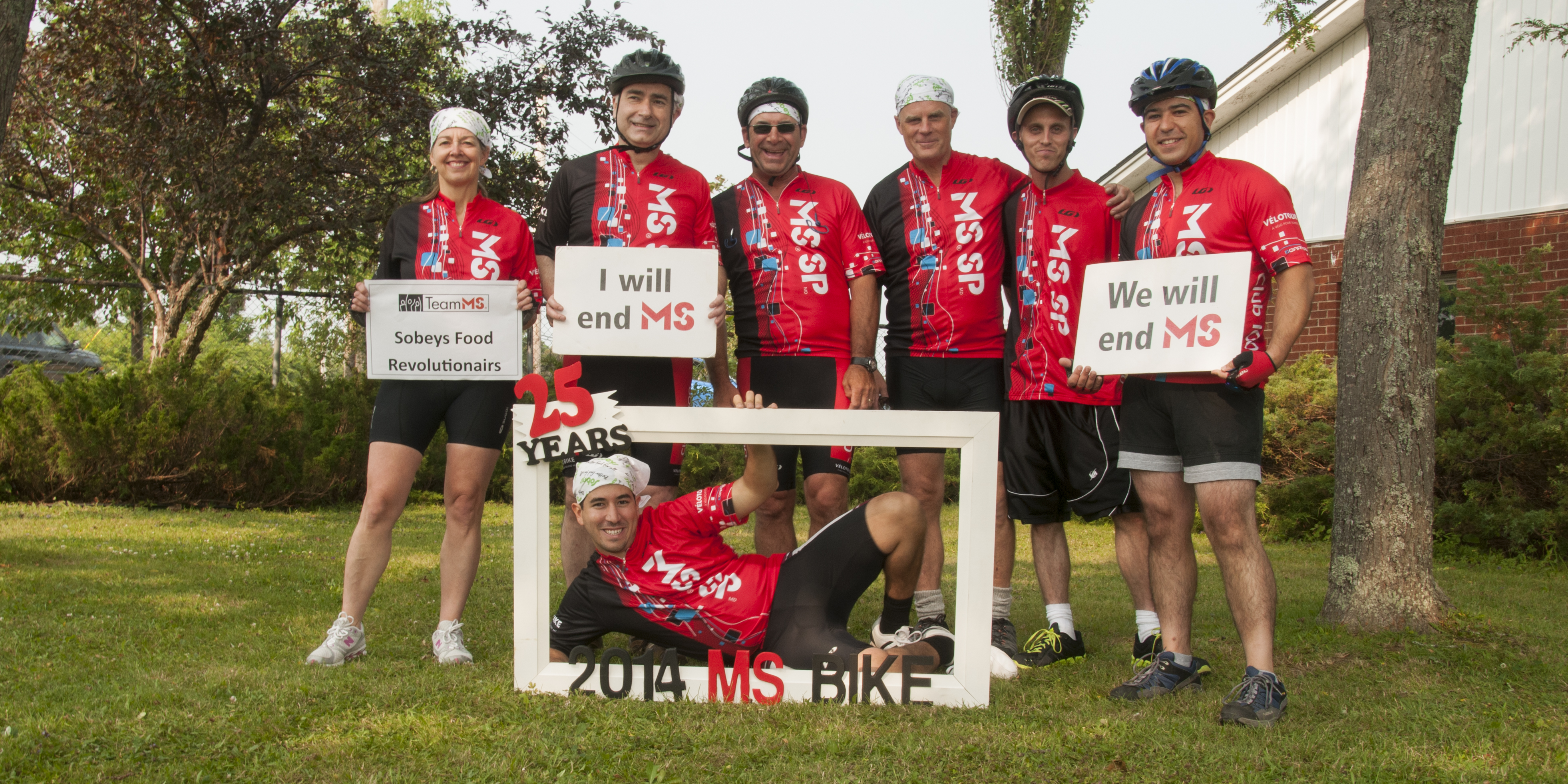
This brings us to 2014, and I had since taken on the pharmacy manager role at Sobeys. I was connected to a store manager in town who had also ridden on the tour and wanted to start up a corporate team. We brought 5 stores into the fold and pooled our riders fundraising efforts with a goal of $10,000. We had store BBQs, a poolnight, and two paintball afternoons. We had casual days for staff, we sold MS oatmeal cookies from the bakery, and sold 50/50 tickets. We went on to raise almost $14,000 for the fight against MS. Not too bad for year #1.

2014 MS Team

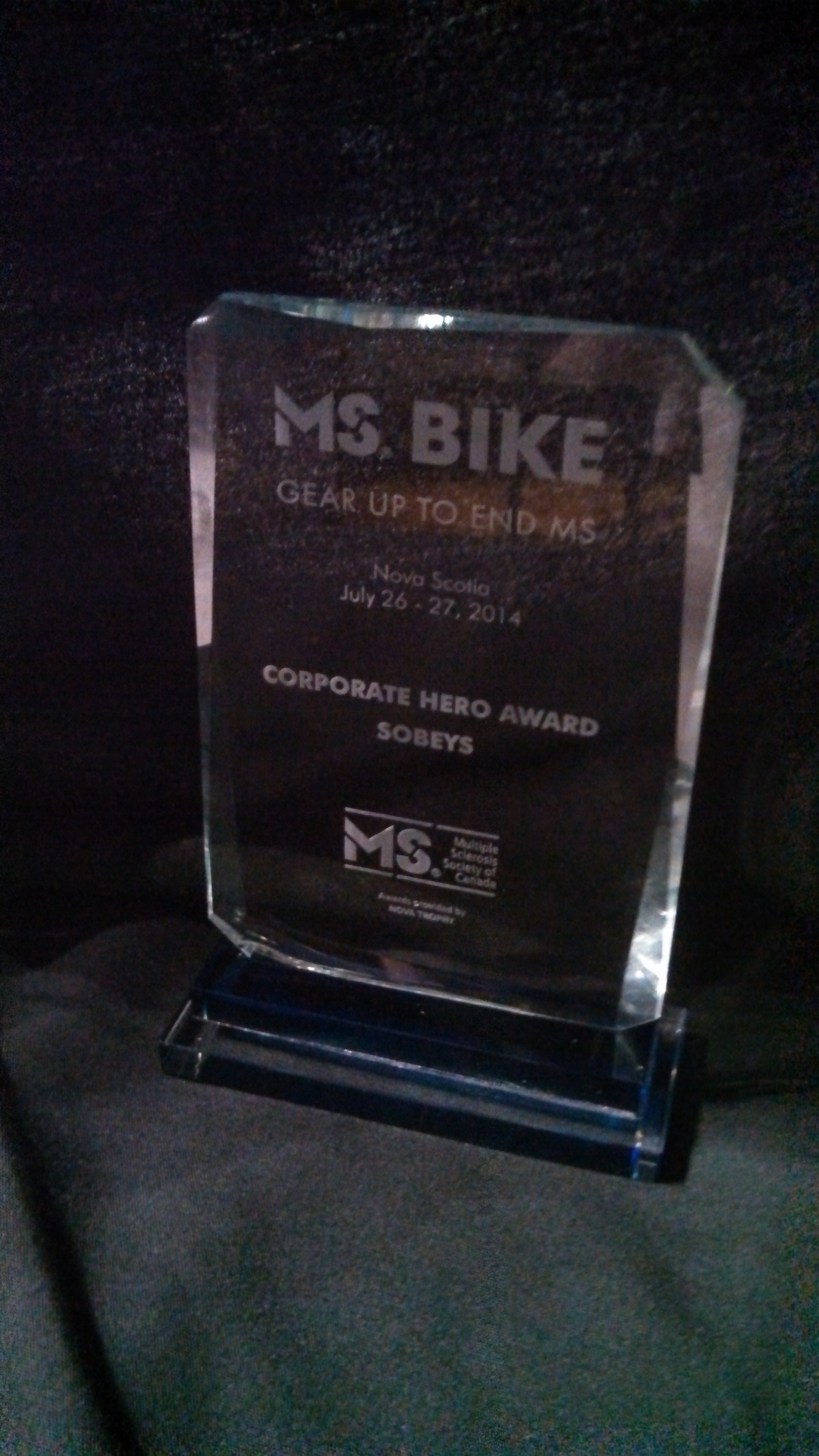
I was apprehensive leading up to the ride. I had hoped to see members of my former team but wasn’t aware of where they were staying or who would be attending. This new team was a hodge-podge of riders from different stores, and none I knew well. My fears were allayed once we arrived at Acadia. My former team members were two floors down in the same residence and we hung out exactly the way we did in previous years. I even ran into a friend I had not seen in well over a decade cutting fruit in the cafeteria (Nice to see you HB). Our team was the newest of the three corporate teams on tour and managed to take home some hardware for our efforts:


Corporate Hero Award 2014-MS  Team Cheer Award - 2014-MS

Our cheer was to the theme of Gilligan’s Island. Not everyone in attendance got the reference.


So why was this the best one yet? I didn’t train as much, and had a pair of dead legs 3/4 of the way through, so that wasn’t it. I doubled my previous personal best in fundraising, but that wasn’t it either.

This was the first tour that I felt like a leader. New riders would come to me for their preparation and itinerary. MS Society staff called me by my first name. Most importantly, I had a new appreciation for the passion and dedication shown by the staff, volunteers along the route, and the 330 riders who participated. People were giving of their time and energy to help others not because they were forced to, but because they wanted to. It’s contagious;  we spent the whole night planning fundraisers for next year’s event. I know I’ll be recruiting some of you to join me on the 2015 ride.

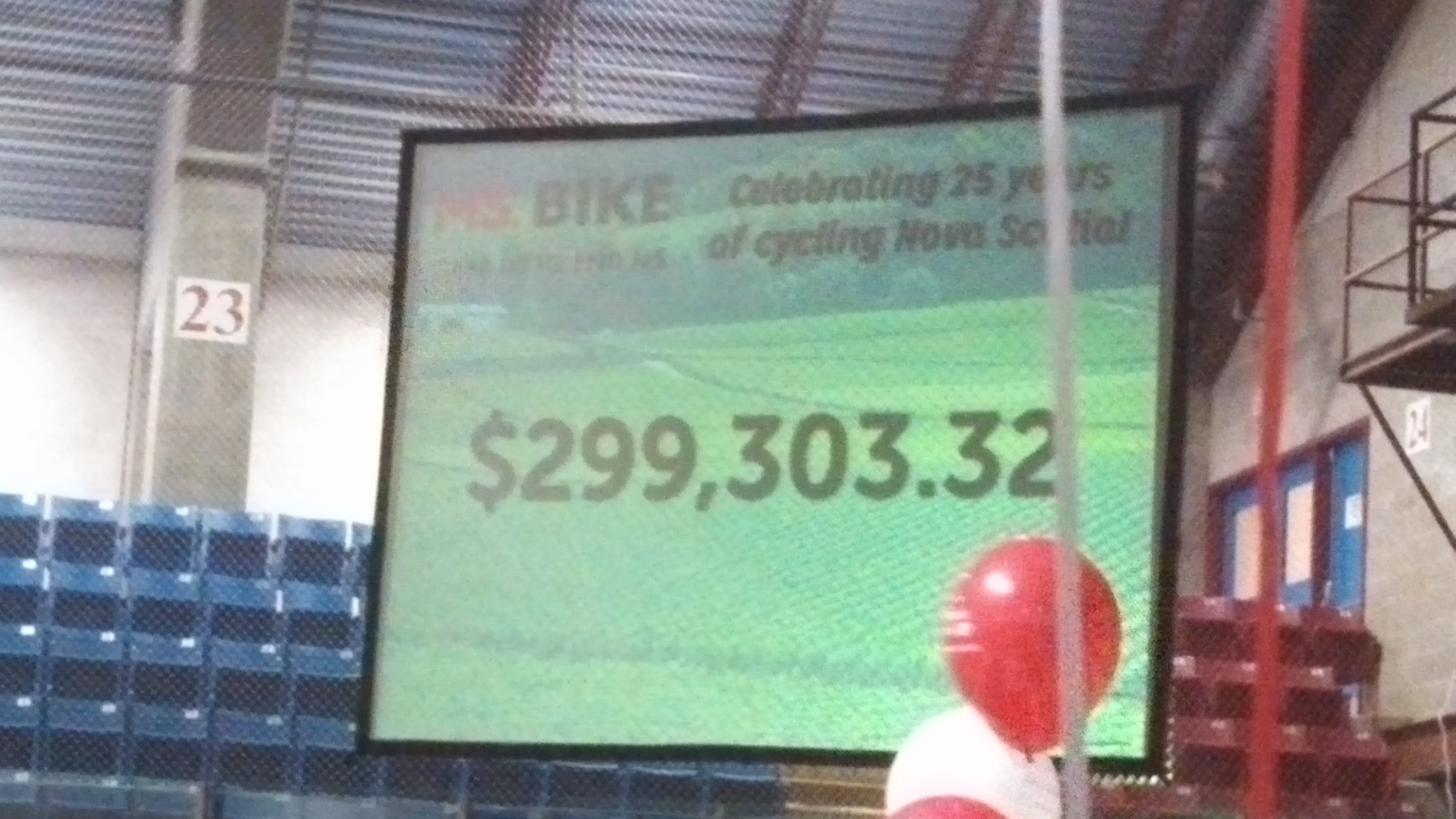
When it’s all said and done, we really did pull together to make a difference in the lives of those suffering from MS. Drum-roll, please…

MS Tour Total 2014

Makes it all worthwhile, doesn’t it?


Disclaimer: The views and opinions expressed in this article are those of the author(s) and do not necessarily reflect the official policy or position of any agency, employer or affiliation.
The Lighter Side

Sometimes it’s just more fun to observe the pharmacy world day-to-day and let the posts write themselves 😀

1) ‘uid’ vs. ‘od’

When I started as a pharmacist in New Brunswick a decade or so ago, we had a family physician who probably graduated med school not long after the Second World War. To say his style was old-fashioned was definitely an understatement. One of his quirks was that he exclusively wrote ‘once daily’ as ‘u.i.d.’ Just try to Google it…you won’t find much. My best guess is that it was an extrapolation of the Latin abbreviations b.i.d. (bis in die = twice a day), t.i.d. (ter in die = thrice a day), etc. The Latin word for ‘one’ is ‘unus’ so perhaps this kindly gentleman wanted to differentiate his abbreviation from ‘u.d.’ (ut dictum = as directed). I don’t know how many phone calls he fielded, but as a new relief pharmacist, I thought I was losing my mind.

On a sidenote, the French way to write for ‘one tab orally once daily’ looks like ‘1 co po die’. The first time a doctor ran that together on a script, it took me 10 minutes to figure out what a ‘copodie’ was.

2) I had a good chuckle with a doctor a number of years back when I questioned why he was calling in ‘Trazadone 50mg, same as before, sixteen years refills’.

It didn’t immediately occur to me that he meant, ‘sixty, and a year’s refills.’ Say it fast, you’ll notice it sounds very similar.

3) Auxiliary labels come in a variety of colors and serve to remind consumers of more common instructions or warnings for their medications. Unfortunately, limited colors mean that in a pinch, users may on occasion grab the incorrect label for the prescription in hand. Not to make light of human error, but I would sincerely hope that proper counseling would cause someone with a chest infection to question if their clarithromycin prescription was ‘for rectal use’.

4) Erectile dysfunction is a sensitive topic but an important one. It predominantly affects older males, though sexual dysfunction is also diagnosed in women more often than people think. Common prescription medications used for depression may also create these problems. Even after practicing all this time, it’s difficult to know just how comfortable someone will be discussing their affliction the first time they pick up a prescription therapy. I give you a few simple ‘Do’s and Don’ts’ that I believe to be helpful from MY past experiences.


DO

– Treat as any other prescription: respect confidentiality, offer to counsel and answer questions.

– Offer a phone consultation if that would be more comfortable for the patient

– Ensure that they have discussed risks with their doctor with respect to cardiac troubles.


DON’T

– Get caught in a counseling session with a pen that looks like this:

the-spring-pen-514

(Image courtesy of http://www.custom-product.com/)

I wish I was making this up.

I was running out the door for an errand and as the only male pharmacist on staff that day, a patient requested I counsel him on his new ED medication. Since I did not have my lab coat on, I happened to seize a novelty pen dropped off on a recent drug rep visit on my way. The patient’s comment was something like, ‘looks like the pen needs this more than I do.’ We both had a great chuckle, though my embarrassment was definitely apparent.


Oh, the world of pharmacy…do we ever run out of stories?


Disclaimer: The views and opinions expressed in this article are those of the author(s) and do not necessarily reflect the official policy or position of any agency, employer or affiliation.


Life Outside Work

The nature of a job in a health profession is that we care for a living. If you ask anyone in the health field to define their job, most definitions will include some iteration of “I take care of my patients.” This is the most rewarding and exciting part of our job. It can also be the part that wears us out the fastest.

I remember finding out that one of my patients had had a resurgence of breast cancer. Her partner came in to pick up her pain meds and told me the terrible news. I cried with her and hugged her and told her I’d be there through it all to help them both. When that patient passed away, I cried and hugged her partner again. This is the sort of stuff that I bring home. Third party issues, doctors calls, injections and med reviews can all be left at work;  it’s the emotional side of caring for my patients that often makes its way into my psyche and hitches a ride home with me at the end of the day.

It is well-documented that health professionals often put themselves last. We do a great job of caring for other people but are not so great of taking care of number one. I can also attest to the fact that if a pharmacist (i.e. myself) is not in top emotional and mental health, work will suffer. A bout of depression does not bode well for accuracy and enjoyment at work.

So, how can we wage war against burn out?

I would argue the answer to the question is not more vacation time or shorter work weeks. It’s having a hobby. Recently, I have taken up wine as a hobby. Not in the “come home and drink a bottle of wine” sense. I have been taking wine education classes and am currently enrolled in the sommelier program put on by the Canadian Association of Professional Sommeliers. Once a week I have a four-hour class on the history of wine, how grapes are grown, grape physiology, how wine is made, etc. I also have papers to write and exams for which to prepare. I love absolutely everything about this course. It is so very different from my daily work experience. It is giving me a totally new and different set of skills. I am meeting new, like-minded people who share my passion for the history, science, and art of wine making.

Now, you’re probably reading this and asking, “but Laura, what does this have to do with me?” No, dear readers, I do not suggest that the key to happiness at work is to enrol in wine school. The point of sharing my story with you is this: having a hobby gives you an out. It allows your mind to escape into a place that has nothing to do with the wonderful world of pharmacy.  As a bonus, pharmacists pride themselves on being lifelong learners. A hobby has the ability to massage a different part of the brain that has been left dormant for too long. New skills can be learned and enjoyed. It gives you something to look forward to that is different from the day to day grind of getting up and going to work.

Do you have a hobby? Do you like to cook, or go to karaoke, or take in Zumba classes twice a week? Do you paint? Is there something you’ve always wished you could do? If you are looking at this article and thinking that you’ve always wanted to take an art history class then I say do it, friends. Join the running club you’ve been thinking about. Sign up for the pottery class you’ve been eyeing. Yes, it will take extra time out of your schedule. Yes, you may have to miss a class every so often. But I can tell you from personal experience that the richness a hobby will add to your life is worth any investment.

Here is a link to HRM recreational programs: http://www.halifax.ca/rec/documents/online.pdf

This would be a great place to start if you’re looking for a new hobby. Programs tend to be inexpensive and cater to any ability level. So here’s to getting out there and having a life outside of work!


Disclaimer: The views and opinions expressed in this article are those of the author(s) and do not necessarily reflect the official policy or position of any agency, employer or affiliation.
One Year in the Blink of an Eye

It’s a wee bit stormy out here on the east coast. Spring has decided to pack up and go to Florida to avoid 30cm of blizzard leftovers.

I’m in awe that 1) it has been a full year since I published my first post on PharmAspire titled ‘Inspiration‘ and 2) as my gender is not always known for remembering certain occasions, I have earned my gold star on this day.

It has been a banner year for personal and professional growth. Even from post #1 the tone and feel of the blog is exactly how I had originally envisioned it: a place to explore all of the positives in our lives as pharmacists in the words of those living it. Other places may serve to spotlight all of the crazy/annoying/mundane aspects of our profession and it’s often a good laugh, but at the end of the day, it keeps the mind trapped in all the things we dislike about what we do. At the very least, what can we take from those examples to illustrate what we have control over to improve the situation for the next time?

It was never meant to be all about me, and consequently, many of the experiences I’ve had over the past year have been shared with or inspired by others. A couple of other author-friends have taken a turn writing their own pieces, and they are certainly worth a read.

Reviewing some of the topics covered, we have delved into job satisfaction and handling ‘no-win’ situations. We have taken on mental health in numerous posts, including mobile outreach, community group participation and addiction. There have been heavy topics (suicidal ideation) that have balanced with lighter fare (Odds & Ends). Current events in Nova Scotia include the journey towards technician regulation and our first foray into administering injections. Quite a mixed bag, wouldn’t you say? All posts may be found in the archives if you’d like to check them out.

All in all, and I repeat myself often in saying that it’s been extremely satisfying to watch this blog idea grow. It has reached more people than I could have expected in such a short time. To top the year off, the blog is being featured in the March 2014 issue of Pharmacy Practice +. I am both honored and humbled by the support I’ve received.

A sincere thank you goes out to Laura M, who has been my blog editor since day 1. My ideas are sometimes convoluted and my metaphors don’t always make sense. I’m so glad she has stuck with me and pushes me to be a better writer.

So what’s in store for year #2?

A lot has happened in the pharmacy world and continues to happen. As I wade through my own experiences with expanded scope and collaborative practice, I hope to share as much of the highlights as I can. Plans are in the works to continue mental health outreach with the More Than Meds project (http://morethanmeds.com). Other upcoming features include further follow-up on my smoking-cessation sessions, a deeper look into palliative care, and a profile on a new provincial initiative (http://polypharmacy.ca).

Stay tuned!


Twitter: @PharmAspire

Facebook: https://www.facebook.com/pharmaspire.ca

email: dcovey@pharmaspire.ca


Disclaimer: The views and opinions expressed in this article are those of the author(s) and do not necessarily reflect the official policy or position of any agency, employer or affiliation.

The Unexpected Experience of Mental Health Outreach

Since May, I’ve been a proud member of the More Than Meds team (@morethanmeds, http://morethanmeds.com). I’ve been led off the beaten path of conventional community pharmacy and have begun to test my own beliefs about mental health and stigma that goes with it. I’ve certainly had my eyes opened, and many doors and opportunities too. I think it is fair to say that being a part of this program has really helped me to better understand what patients and their families go through on a daily basis – the hope, exasperation, set backs, isolation, support, and progress. This understanding didn’t happen by remaining in the dispensary.

About four weeks ago, I was invited to attend a meeting with family members of patients struggling with psychotic and schizo-affective disorders. This group has been meeting monthly for about 10 years now. From what I observed, they have grown into a big supportive family. Mostly there were couples, but some single parents attended. Each would provide insight and support to the others in the group by sharing their own experiences with mental health services, inpatient stays, the multitude of care providers, challenges with housing, and of course, the medications. While I am very familiar with the commonly used psychotropic medications, I am far out of my comfort zone when it comes to addressing the non-pharmacological issues of mental health care. While I knew it on some level, being at the support group really crystallized for me the importance of being much more than meds (see what I did there?). Educator, navigator, collaborator, and advocate (definitely advocate) roles make much more sense now, whereas before I didn’t really ‘get’ how to fit them into my practice. Quite frankly, I was overwhelmed by how much information I had to offer. Information that they needed, information that brought the members of the group understanding and clarity and/or new therapeutic paths to follow. Their appreciation was more than humbling.

During a round-table discussion, a member of the group touched on something that I can’t seem to shake, and I paraphrase:

“Our son lives with schizophrenia. He’s been doing well of late. His meds are stable. He is living independently. When he was a teen, he was a gifted athlete and musician. Now mostly he plays video games. We actually get concerned that he has stopped his medications when he gets back to playing music…and he’s really really good!”

This comment really struck me, flooding me with all sorts of thoughts and mixed emotions. This illness, especially the negative symptoms, is so frustrating to families, and to me. What can we do to help? Are his medications stifling his creativity? The concept of blunted affect has been written about extensively (http://en.wikipedia.org/wiki/Blunted_affect, http://www.ncbi.nlm.nih.gov/pmc/articles/PMC2632232/). Would suggesting a change in his pharmacotherapy be a good idea? Does it keep hope alive or set up false expectations? How do we say in so many words, “things could get better. Would you like to try (x)”? Simply by saying it we are, in fact, pointing out that the current situation is somehow unsatisfactory, but who are we to judge? This may be counterproductive as it may only serve to cause the family frustration rather than hope. As pharmacists, we may struggle to determine our role in these situations. We do not title ourselves as mental health care specialists but we do contribute to mental health services. In a broad sense, we contribute every time we speak with someone about their sleep, their mood, their worries, and the medications that affect those things.

That said, I am glad that I chose to accept the invitation to speak. Even just to be a part of  a community searching for help and support. On the topic of medication regimens: sure, they help the families and caregivers cope. They can also provide stability, the lack of which could otherwise prevent the return to work or leading to the loss of yet another relationship. However, not everyone likes the medication experience. It’s been said that the cost of stability may be a little less color in one’s world. For that evening, I may not have had all the answers to their many questions. I may not have been able to recite the most relevant head-to-head trials or know all the rare side effects for each medication, but I learned that my imperfect knowledge and my experience allowed me to give so much in the way of support, information, and encouragement.

After a couple of sessions with families and patients, I don’t consider myself an expert but I certainly feel that my awareness has changed for the better. I hope to participate in more evenings like the one mentioned above.  I know my daytime patient care activities will benefit from it.

Disclaimer: The views and opinions expressed in this article are those of the author(s) and do not necessarily reflect the official policy or position of any agency, employer or affiliation.