Big Boys Don’t Cry


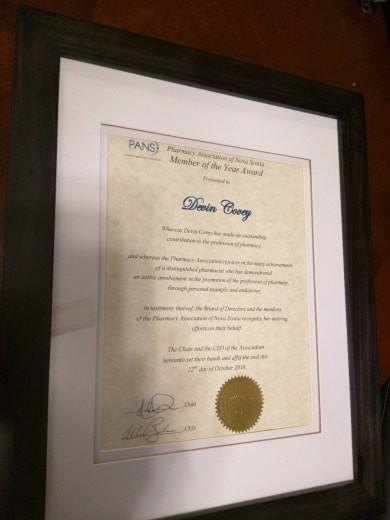
I  was honoured and humbled to have received the Pharmacy Association of Nova Scotia’s Member of the Year Award a few weekends ago and wanted to comment on my experience at the ceremony.

My speech was blended, processed, and re-hashed in my head for the 3-hour lead up to the announcement. All I knew is that I had folks to thank, but didn’t know in which order or whether I could hold it together long enough to sound coherent.

In holding it together, I’ll admit that I failed a little.

My temptation, like many others before was to make excuses as to why it was just amazing to be nominated, or there are others more deserving. A mentor shut me down early on by saying, ‘This award is for you, but it’s also for us. We are recognizing contributions to the profession that impact us all, so say thank you, and get up there’.

Neville MacKay was the presenter/emcee for the evening and what a treat! Neville is a well-known personality on TV and radio, and somehow finds the time to run My Mother’s Bloomers, a floral services shop on Spring Garden Rd. His schtick (as he refers to it) is a mixture of comedy and inspiration. He will often demonstrate beauty, diversity and teamwork by weaving in floral creations on the fly. He kept everyone light. Even in moments of solemn reflection for a lost colleague, the venerable Larry Broadfield, he found a way to honour his legacy by cheering the crowd up in his spirit.

So the mini-bio was read, and then the video started. This video was shot earlier in the summer and featured interviews with a number of my own staff as well as staff from this year’s pharmacy of the year award-winning store. I had not seen the footage until that night, and days later, I’m still spinning from the kind words that were said. I’m truly grateful for everyone with whom I’ve had the pleasure to work. It was touching and heartfelt. With a nervous tremble, I shook Neville’s hand, and that of the outgoing association president.

A little side-note about speeches. I may like to talk too much, but that’s very different from the idea of giving a speech. Thinking this was going to be akin to graduation, where you stroll across a stage, receive a certificate and fade off the other side, my preparation was minimal. At least I had the foresight to keep my wine consumption during dinner to a reasonable level.

So start with a funny anecdote, that will buy some time, right? Neville, and his limited pharmaceutical knowledge had made an earlier crack about that ‘little blue pill’. I saw that as an opportunity to jump in with my story about counseling a gentleman with a new erectile dysfunction medication whilst holding a floppy, slinky-esque novelty pen. Certainly not a shining moment. Now onto the serious stuff…

In order, I thanked my wife Diane, but only after gathering myself. Fady, the manager at the retail store next to where I’ve been working, deserved praise not only for his store’s well-deserved award for outstanding commitment to expanded scope prescribing and injection services, but for taking the time to nominate me for such a high honour. The Association executive was thanked for hosting such a wonderful event and the Association members in attendance for sharing their experiences and successes throughout the weekend. Finally, I had to acknowledge the other recipients for letting me share in their special night. I hope it meant as much to them as it did to me.

I faltered in getting the last few words out, and my voice trailed off into nothing. I slowly trundled back to my seat.

So why have I spent 700 words to recount my gala experience? Mainly because this blog has been the outlet where I can be me, and one of the main reasons how I came to be on that very stage. Being recognized by a patient, or someone close to you is an amazing feeling. When it’s a group of peers, of mentors, of leaders…it means so much. This is a thank you to all of the people who have helped and supported me through the years, inside and out of my career. You’ve shared in my highs and lows. You’ve indulged my thoughts and words in conversation and on these very pages.

I promise to keep the waterworks to a dull roar 😉

thumbnail_img_20161023_192439


Disclaimer: The views and opinions expressed in this article are those of the author(s) and do not necessarily reflect the official policy or position of any agency, employer or affiliation.
Learning to Lie in the Bed we MAiD

June 17/16 was a historic day in Canada. It was the day that bill C-14, legislation on medical assistance in dying (MAiD) received royal assent.

Picking the title for this post was tough. The pun idea was what initiated the post in the first place, but reading it may imply a lack of respect which is unintentional. My feeling is that Canada took the bold step to acknowledge that dying with dignity belongs in our consciousness and in how we care for those suffering the unimaginable. Now that this step was taken, and the discussions have occurred, there is no putting the toothpaste back in the tube. Providing patient care in this setting is a marked departure from anything most of us have been involved with in our careers. We are trained to be exacting in our standards and level of detail to prevent patient harm from dosing errors or drug interactions. Recognizing what was always viewed as the most extreme degree of harm as holistic patient care is not an easy feat.

It’s no surprise the debate was prolonged. The subject of death in any form is an extremely sensitive topic. It’s never supposed to be a planned event, and when it is, it’s associated with tragedy and unanswered questions. There is now a provision in the criminal code for an individual to seek assistance in ending their personal suffering on their terms without penalty to themselves or the healthcare providers involved in carrying out those final wishes.

In Nova Scotia, the regulations make clear the pharmacist’s involvement. In my opinion, the document is transparent, and is well-written. Should our team be approached with a request, we’ve discussed our comfort with the sourcing and dispensing of the medications (some of which we’ve never actually dispensed in retail). We understand our role in the process, and those of the physicians and the nursing staff. Still, when the request is actually made, it’s difficult to predict the emotions we will feel…and that’s perfectly okay. I’ve spoken with colleagues that have been approached and they describe the process as extremely collaborative and supportive. In the lead-up, it’s all about following the protocol: receiving the orders, collecting the medications and associated supplies, labeling the kits, and arranging dispensing to the responsible physician. It’s usually only after the required notification is received that the gravity tugs a little stronger.

The CBC published an article in May of this year with a province by province snapshot of the developing guidelines based heavily on the Supreme Court ruling in the case of Carter v. Canada in Feb 2015. All had defined criteria for eligible candidates, and all outline ‘effective referral’, a clause requiring any health professional unable to provide service themselves to ensure that it is received. Not everyone will be comfortable with medically-assisted dying and we respect those who decide not to participate. Since that point, there have been additional provisions and court challenges that deem the laws too restrictive, so the conversation is far from settled.

In closing, I don’t usually like to provide opinions on controversial topics. We are a community of mostly pharmacists and complementary health care providers, meaning one opinion is one voice, and no more or less important than that of a fellow pharmacist, nurse, or physician. I have been asked, and to me it really comes down to the individual making the request. If they were my loved one; a spouse, a sibling, a parent and they were suffering helplessly, would I wish for them to have that choice? Would I wish to have that choice should my health decline to the point where comfort measures are the only form of therapy available? As many times I’ve replayed the arguments, I seem to always settle on ‘Yes’.

If you have not already done so, please read the decision and the MAiD materials before you are called on to respond. Whether you participate is a deeply personal decision that can not be made lightly. History will never be undone, so we all need to be at peace with how we move forward and evolve with this change.


Disclaimer: The views and opinions expressed in this article are those of the author(s) and do not necessarily reflect the official policy or position of any agency, employer or affiliation.

Procrastination Factory

I’ll be honest. I’ve been putting off writing this all day.

I may sometimes question my abilities: how well I deal with HR situations, or whether my injection technique is as refined as it should be. There is no doubt of my innate ability to waste time. The majestic piles of nothing produced can be quite stunning. Particularly on weekends, when my attempts to relax often begin with mental checklists of household chores, lawn projects, and family outings we really should start attacking before the weather cools. By Saturday morning many items have been removed from the list and deferred to the “next weekend” pile. By Sunday afternoon, the list is empty with all intentions that priority items will somehow happen through the following week.

Labour modeling and analyses to complete? What better time to rip and rename my CD library into iTunes. The completed staff evaluation that still needs to be formally written? Well, level 816 of Candy Crush sure isn’t going to solve itself. The possibilities are endless, and my creative vices take charge to ensure the productive task gets arrested and thrown into a windowless room. After another 3 hours of browsing celebrity impressions on YouTube, a guilty conscience finally forces me into meaningful action.

At this moment, I realize that a preface would have been useful to explain that I do consider myself a hard-working and productive person most of the time. In fact, some of my best work has happened at crunch-time when there’s no room to dawdle. My oldest will have 2 weeks to deliver a book report, and there she is scrambling the morning of, scribbling on cue cards while she waits for the low rumble of the bus. Ah, that takes me back.

The worst part is, many of the tasks aren’t particularly challenging, or physically draining. Once I’m started, it’s usually perfectly fine. Things get done, a line gets scratched off the list, and a satisfying feeling overcomes me. Things like going to the gym are a bit different, as it’s a fight as soon as the idea pops into the head. That’s usually when the lawn gets mowed, or…


Okay, wait. Just hold on a minute

It’s 7:35am … I think Devin’s been trying to write this post for like 3 weeks now.   Hi, this is Diane, his lovely, non-procrastinating wife.  I am on the opposite end of the procrastinating spectrum.  So it can be a challenge trying to us to work on projects together.  I have a to-do list every single day.  If there’s a deadline, I’m usually the keener that has it done like 3 days beforehand (ok, maybe even 5 days).  I’ve  learned that if I do procrastinate, it usually stresses me out more. We currently have a membership due to be renewed in November. I know I should wait until November to renew it, but why did they send us the renewal notice already?!  Now it’s going to be on my mind ( and on my to-do list)  for 2 months….

So after 15 years of marriage, we’ve learned to compromise. When we need to get somewhere for a certain time, I have learned that Devin will always get us there right…on…time  (even though I would probably like to be there 5 minutes before). Just like Devin has learned that some small things on my to-do list are actually items for  the honey-do list. I know that after a bit of prodding, he’ll do it, just so  I can stop stressing  about it. And sometimes, like this post, I hear him say:”oh crap I really have to finish XYZ” and I hear it for a couple of times, and I mentally add to to my do-to list to remind him. Other times I’ll just go ahead and do it. I usually don’t interfere with his posts, but I couldn’t resist this one. So here it  is… Post complete! 7:55am – Oh, and laundry is in  the wash, clean dishes put away, young one off to school, older one ready to get on the bus 🙂


So honey, the moral of the story is that if I put something off long enough, or accidentally leave my PharmAspire edit page open unattended, it will be magically done when I get back? Got it 😉


Disclaimer: The views and opinions expressed in this article are those of the author(s) and do not necessarily reflect the official policy or position of any agency, employer or affiliation.

Hip For a Night

How often do you feel part of something too big to explain in words alone? It’s a sensation; a point in time where everyone casts an eye, bends an ear, and opens a mind to an emotional spectacle only experienced a handful of times a generation.

The Tragically Hip bid farewell to the masses in their home town of Kingston, Ontario and an estimated 11.7M viewers across Canada via an uncut CBC live feed on August 20. I certainly won’t find the right words, but I’ll gladly take a lunge at it.

Lead singer Gord Downie was recently diagnosed with glioblastoma, a terminal brain cancer that grows aggressively and offers minimal chance at long-term survival. He decided to do the opposite of what you might expect; instead of becoming reclusive, accepting what remaining quality-of-life measures were available, and letting us mourn in advance of the inevitable, he organized a final tour to share himself with the fans one last time.


“Courage…It couldn’t come at a worse time.”Gord Downie, Courage

However ravaged his body appeared after a craniotomy and six weeks of chemo and radiation, the energy from all pockets of the country seemed to fuel his voice after every introductory riff. Each of the three encore sets reached a fever pitch, and without interruption, we could hang on every solo, every iconic lyric, each instance of a certain signature, tumbling cadence to cap the vocal line.

That night I wasn’t a pharmacist. I was a Canadian…and a damned proud one at that.

The next morning, Laura and I were chatting about the significance of the concert. This exchange captured what many of the articles and pundits had been reporting:

Me: Any way I can tie in the Hip concert into a pharmacy blog post?

Laura: Oh God, I cried through the whole concert last night. Their bravery and COURAGE was unbelievable.

Me: I know. Read an article about Gord burning out onstage for everyone. Pretty amazing stuff.

Laura: They played for three hours.

Me: After the first few songs, I felt he was straining hard, but he kept going.

Laura: Yeah, and a lot of classics later on he sounded amazing. Imagine spending that much time and energy with four other guys for thirty years. They know exactly what they’re all going to do. Remarkable really.

Me: Can’t imagine. They deserve the adulation. If you’re going to hero-worship anything, this feels right.

Laura: Canadian pride and caring less about what others think is a surefire way to a happier life. Tonight the ENTIRE COUNTRY stopped to watch a concert. Would that happen anywhere else in the world? 

The CAPS are unedited, and proper emphasis is where it belonged 🙂


“No one’s interested in something you didn’t do.”Gord Downie, Wheat Kings

I could take a fatalistic approach in saying that many cases of malpractice litigation definitely hinge on things that weren’t done, but I digress…

In all seriousness, wiser words have not been spoken as a mantra to living all phases of life. As pharmacists, how many minor ailments have we failed to offer? How many open-ended questions have we failed to ask? How many turf wars do we concede to other health professions? How many courses have we failed to take? How many trips have we failed to plan? How many opportunities have we failed to grasp? None of these examples are malicious or vindictive, just oftentimes we remain passive because of the emotional investment and unknown consequences.

Laura really drove the point home for me:

“So let’s remember what Gord and the Hip did on Aug 20. They gave everything they had left to their fans in one last hurrah. Every Canadian, healthcare professional or not, can stand to give a little more to others, care a little less what people think and get on with living their best life.”


“No dress-rehearsal…this is our life.”Gord Downie, Ahead By  a Century

Everyone’s watching. Work, play, practice..LIVE on your own terms. 

#InGordWeTrust


Disclaimer: The views and opinions expressed in this article are those of the author(s) and do not necessarily reflect the official policy or position of any agency, employer or affiliation.

Dog Days

My last post was over a month ago. Wow. I could make an excuse about being lazy in the summer, or that I’m spending more time outside, but alas, I am bereft of anything plausible other than that my attention has been elsewhere lately. One such distraction has been biking in my 6th Multiple Sclerosis Bike Tour, which I hope to write a bit about in the near future.

Sunlight can be a blessing for those who work in offices lacking windows. In our case, every time the receiving door opens is an opportunity to check the weather. We all could use a nice little Vitamin D rush in the mid-afternoon, even just to daydream and recharge for the late day push. A number of years ago, a team leader spoke about the importance of natural light in the workplace, and it’s hitting home more now than ever.

This summer is happily flying along and with it, the annual summer vacation crush. Manpower/womanpower is tighter than usual and we try to keep things light by ordering the occasional Friday afternoon pizza and testing the spring & summer demo releases from an in-house Scentsy(TM) consultant (Ed. note: Weathered Leather is not the best aroma for a small office).

So amidst the daily slog, a couple of days ago I found it fitting to be asked where I thought the profession of pharmacy is headed. At a time where I’m covering two roles and am measuring my progress hour by hour to stay on top of clinical responsibilities, this question forced me to think in terms of not just where I saw myself headed in pharmacy, but our path as a collective group. On the spot, my answer was reasonably coherent and built on the theme of professional independence; pharmacists focusing on the assessment of patients instead of treatments alone, becoming more involved in collaborative practice agreements, and building on the confidence gained through prescribing for minor ailments.

Upon reflection, I’m not satisfied with my answer. Being the excessively wordy fellow I happen to be, there wasn’t enough depth in what felt like a superficial soundbite. So I decided to go back and revisit the title of my blog.

PharmAspire was developed because I wanted to write about the pharmacist I aspire to be, in hopes of relating experiences of colleagues. There are many facets to this, and it’s not just one behavior or one skill that I may acquire; it’s more about bringing myself, my personality, my individual style as it were, to the practice of pharmacy. My opportunities will be borne out of my passions (analytics, team-building, communication) and my personal growth as a leader. I’m not sure how it will look but as the tagline reminds me, I would like to practice on my own terms, and describe the journey in my own terms.

Fear not, the blog-holiday is now over. The dog days have taken their bite and it’s time for some new inspiration. September will be here before we know it. New pharmacy students starting a new school year. Flu outbreaks will be the talk early in the fall. So much to dive into…


Disclaimer: The views and opinions expressed in this article are those of the author(s) and do not necessarily reflect the official policy or position of any agency, employer or affiliation.

Time is Relative

After vacation, you could say we encountered some rather bad luck. I say we, but the sympathy should be reserved for my wife, who after two days back at work, suffered a nasty fall and shattered her olecranon. My diagnostic skills are weak in this area, but my hack medical description of this injury would place it as a Type IIIB, replete with instability of the forearm and multiple fragments. Lest we say that it wasn’t funny at all (cue collective groan).

Having never had a catastrophic injury before, when I received her phone call that something was wrong, her voice was a bit higher-pitched, but the timbre and inflection didn’t suggest anything worthy of alarm. In fact, she seemed more concerned about a set of keys that dropped through a sewer grate during the tumble. Assuming shock was playing a part, we arrived at the emergency with the arm immobilized, and she proceeded to sit and read her book for 4 hours in the waiting room. She felt some discomfort when she tried to move, but no agonizing pain. We were both aghast when the doctor returned with the x-ray results; her ‘bad sprain’ would require immediate surgery. In hindsight, the fact she could no longer locate the knob of her elbow probably should’ve been a giveaway.

So the ER doc forwarded paperwork to the main hospital, but it was one in the morning and the services were closed. So he applied a cast, asked she refrain from eating or drinking, and head to the hospital at 9 in the morning (basically cast, fast, and last). The morning comes, they take x-rays, perform a work-up triage, and….send her home…on a Friday. The new instructions were to start fasting at midnight, and wait by the phone for a possible call in the morning. Saturday morning rolls in and no call. Now I might add, she is not taking anything for pain, just frequent icing and sleeping uncomfortably in a chair with a cushion supporting her thankfully non-dominant arm. By 3pm, I’m calling the hospital myself as she now hasn’t eaten in over 15 hours. Lo and behold, the nurse had thought someone already called. No surgery today due a multiple trauma situation. Repeat the midnight fast. Two MORE days go by until she gets in on the Monday morning. With a little hardware insertion, she is now partially bionic and taking on any arm-wrestling challengers (kidding).

Through the ordeal, we realized that as pharmacists entrenched in the healthcare system, we are providing care to patients, and don’t often ponder the role of the consumer. To find ourselves on the flip side dealing with the uncertainly of a foreign process, we honestly had a frustrating few days. Healthcare is often measured in units of length, not quality. How long will it take to fill my prescription? How long is the wait in the emergency room? How long is the wait list for my carpal-tunnel surgery?

As a provider, we understand all the moving parts and systems that help us deliver quality healthcare. The time we take to ensure we’re being prudent, thorough and safe can not be understated. To us, 30 minutes for a prescription may be completely realistic so that everyone in line for a medication service will receive the same experience, regardless of whether it’s an injection, a medication review and/or a simple refill. In order to maintain consistency and sustainability, that block of time is necessary for very good reasons.

As a consumer on the other hand, we lacked the understanding, and every missed phone call, or being ‘bumped’ was hard to comprehend. My wife is unable to function for 3 1/2 days; no real sleep, fasting cycles, trouble performing any regular tasks we may take for granted (laundry, cooking, dressing, showering, etc). We’ve since determined that an ‘eternity’ is now defined as 3 1/2 days. Just at the point of feeling helpless and distraught, it dawns on us that we need to trust the professionals to provide us with the best care under the system that binds them. How can we, as pharmacists, expect patients to trust us when we say that their prescription will take the time we quote them, when we’re not willing to give that same latitude to those trying to help us?

So I propose we attempt to measure the time in a different way. Specifically, let’s look at duration of relationships. How long have you had the same family doctor? Did he/she treat your parents or kids? How long has your pharmacist been following up on that pesky diabetes? How long is the history you’ve had with a dental clinic? Usually, the strong bonds you form in primary care are a testament to the quality you receive, and yes, most people will feel it’s worth the wait.

Time is relative. A service may seem to take too long, but merely a speck in what could become a rewarding long-term relationship.


Disclaimer: The views and opinions expressed in this article are those of the author(s) and do not necessarily reflect the official policy or position of any agency, employer or affiliation.

R&R? Part 1

I really tried to resist the urge to write a post about vacation. It’s been a while since my last commentary on being in exotic places and marveling at the contrast in pharmacy services (or lack thereof) in many resort countries and cruise ports. This time around, I still have a few observations to make on that topic, but will intersperse them with more of a general narrative on trying to free the mind of real life, at least for a week or two.

This cruise was planned in celebration of a best friend’s 40th. The thinking went that the kids are getting to the ages where the term ‘family vacation’ may start to become taboo. Maybe it’s that we’re closing in on two decades in our chosen profession, or perhaps watching your generation stepping perilously close to the chasm of middle age is enough to appreciate times when you are absolved of things like responsibility, routine, and maturity. Starting in February when part of my birthday gift was an eye patch for each of the four adult travelers, our adventure on the high seas featured plenty of entertainment. Much of this was not from the on-board shows, but rather the sight of us bouncing around for a week like a pair of giddy goofballs.

Now for the uninitiated, a few observations about cruising:

  • When you’re floating in the middle of the sea, hundreds of miles from land with flat, blue horizon all around, it makes you feel extremely small and insignificant. Paradoxically, it can also be quite a claustrophobic experience; if you follow the routine during sea days, every shop, attraction, buffet, restaurant and bar resembles rows of army ants inching forward in line.
  • Walking preteens through the casino and then having to explain the difference between the slot machines and the games in the arcade upstairs is harder to do than you would think. Essentially the bright lights and colors of the machines just entice you to blow $20 in about 15 minutes and call it ‘fun’.
  • The experience is amazingly multi-cultural. Not just the ports, mind you, but the employees on all parts of the ship have name tags highlighting their native country. We decided to unfurl a world map in our stateroom and have geography lessons with our girls every time we returned from an outing. We met an attendant from Indonesia that works 8 months straight of 12-hour days, 6-days a week. He Skypes home to his young family when the ship is in port and high-speed wi-fi is available. Another one of our waiters hailing from the Philippines jumped up with the house band and performed an admirable rendition of Celine Dion’s ‘Because You Loved Me’.
  • There is this thing called the unlimited drink package. On first blush, it seems to be quite popular for mysterious reasons….hmmmm. Ah, those bars. Perfectly distanced so that you’re never more than 30 paces from a restroom, accessible from the inside and outer deck of the ship, and each seemingly equipped with their own gravity; drawing you close to peruse their unique menu of concoctions.

In part 2, I’ll have some pictures to share and thoughts on pharmacy overseas mixed in with other random observations.

Vacation is always welcome, but it’s good to be back!


Disclaimer: The views and opinions expressed in this article are those of the author(s) and do not necessarily reflect the official policy or position of any agency, employer or affiliation.

Difficult Conversations

That feeling is back.

There in the pit of your stomach, a queasy, uneven terror takes hold. Even the butterflies are frozen in fear. The thought of confrontation can be a paralytic.

This is not just applicable to the pharmacy world of course. A verbal attack, incident of negligence, or general poor attitude can evoke strong reactions from you, other family members, friends or colleagues. Really, any undesirable behavior(s) that affect others may be lost on an individual if they’re not told about it, or asked to reconsider their actions. So how do you toe the line between a proper response and a potential overreaction? A long-time patient violates your trust and is caught shoplifting. A medication incident occurs and you’re cradling the phone receiver to notify a physician that hasn’t always been the most supportive. Say you back into a friend’s car in the driveway after they left it for a weekend away. Perhaps you suspect a family member has a substance abuse problem and you worry about their mental health.

Regular readers may find that I tend to internalize and reflect often. In fact, most of the words I write are borne from some direct or arms-length experience. As a team leader, it’s taken a lot of work to hold back a raw emotional reaction when it festers. If something or someone offends you, it’s important to remember a few things when a potential confrontation occurs:

  • You are entitled to your reaction – Regardless of another’s intent, or their choice of wording, it may offend, insult, surprise, demoralize, etc. and they can’t control your feelings or the reasons why. They are valid and shouldn’t be dismissed. I will sometimes write draft pieces that have a strong topic or controversial nature and I may not realize it. During the editing phase, it’s brought to my attention that for instance, my perspective on technician regulation has been coloured by my growth opportunities in a long-term care setting. It’s something I really hadn’t considered and was thankful that it was pointed out.
  • The earlier the better – Out of the scenarios above, all require a response of some sort. As mentioned, my approach is to internalize and review all possible scenarios, but if I wait too long with a planned response, there’s a chance not only for the behavior or issue to arise again, but it’s also perceived as permissible by onlookers who may become disillusioned.
  • It’s emotionally exhausting, but worth it – Why are these conversations so difficult? If you hold trust and respect for someone, attempting to single out a flaw of some kind without it feeling like an attack is somewhat of an art. I have close friends who are much more adept at meeting with individuals and getting thanked for providing constructive criticism. Almost every difficult meeting I have, I’m usually needing to own up for my own slights or behaviors that have contributed to the situation. See above: they are also entitled to their reaction to something I’ve done or said. Being vulnerable around close family and friends is hard enough, around acquaintances and other professionals is another thing entirely. It’s no surprise that these meetings often happen at the end of the shift, or day, or week even to allow time to wind down.

If you genuinely care, if you are trying to help someone, let that be the basis for an interaction. If the person respects you and your opinion, they often recognize that they have put you in a position to respond. Offering alternatives for moving forward makes the conversation productive while acknowledging past missteps.

Hindsight is always 20/20, but perhaps we can turn that difficult conversation around into something positive with a clear path forward. We can’t guarantee foresight will be 20/20, but how close can we get?


Disclaimer: The views and opinions expressed in this article are those of the author(s) and do not necessarily reflect the official policy or position of any agency, employer or affiliation.

First Aid

It was time for my renewal for standard first aid (SFA) and Cardiopulmonary Resuscitation (CPR) so I registered for the 2-day course and completed my certification last week. This is a requirement to perform injections, but also an expectation as a health professional in the field. Every workplace location should have a trained individual on site at all times.

Is it just me, or does the training seem to change every year?

My first foray into first aid was to earn a badge as a cub scout. One of our group leaders was a trainer with St. John Ambulance and I recall it took place at someone’s house. There were about a dozen of us around the age of 8-10. I only retained a few items from that session: the constant warning of the graphic videos they could have shown us, how to tie a tourniquet, and just how scared to death I was to be confronted with a true first aid situation.

There was so much to remember. During the demonstrations where someone would have to take charge, we all looked at each other with eyes as wide as dinner plates. Almost everyone forgot at least one aspect of the primary survey (introducing yourself as a first-aider, determining multiple casualties, removing hazards, etc.). When manipulating limbs for splints and bandaging, the wrong hand placement led to drops or contortions that would probably do more harm than good. For the CPR component, we would disagree on timing of breaths or whether to do chest compressions first. This was well before the Good Samaritan Act so there was hesitation for fear of doing the wrong thing in the wrong order.

Since then, the training seems to have evolved to be more of a ‘stay calm and collected, assert control, and remember that you’re trying to help the person’. It’s a welcome switch, but watching the scenarios played in the videos are thorough to the point of no longer feeling like an emergency situation. For example, a young girl cuts her hand lengthwise in the kitchen and calls for help. Presumably the father comes in assesses the scene by asking her if anyone else was hurt and check her breathing. He then gloves up and proceeds to check the shoulder all the way down to the arm. The girl does not appear alarmed. By all accounts, this is of course the proper way to perform first aid, but if I was the casualty, I’d wonder why we were spending time doing a head-to-toe assessment. I imagine some folks would be a bit scared and hysterical as well.

CPR is much more simplified. For all cases, a 30:2 compression-to-breath ratio is easy to remember. For choking, the Heimlich Maneouvre (or abdominal thrusts) seemed to have fallen out of favour due to lack of evidence of effectiveness, but is being taught again in combination with back blows. Nose bleeds used to be pinching the nostrils with the head tilted back, but is now angled forward. Shock wasn’t discussed at length like before; if you treat the injury/injuries, then that’s the best way to minimize the effects of shock. Pen devices that administer epinephrine and AEDs are much more direct and straightforward when taught. My biggest disappointment is that tourniquets are no longer in the curriculum; I thought those were pretty cool. Ring pads are out of favour too, as they tend to be unstable on a wound. Pre-fabricated ring pads used to be part of a first aider’s kit. Who knew?

So I should be in good shape for another few years with a re-certification in between. Here’s hoping it’s a set of skills that will be needed infrequently. Should I find myself in a crisis situation, this training may make the difference between a favorable and a catastrophic outcome.


Disclaimer: The views and opinions expressed in this article are those of the author(s) and do not necessarily reflect the official policy or position of any agency, employer or affiliation.