
Waking up spry, we could almost smell the faint scent of maple syrup and beaver tails. Today, we journey to the great white north!
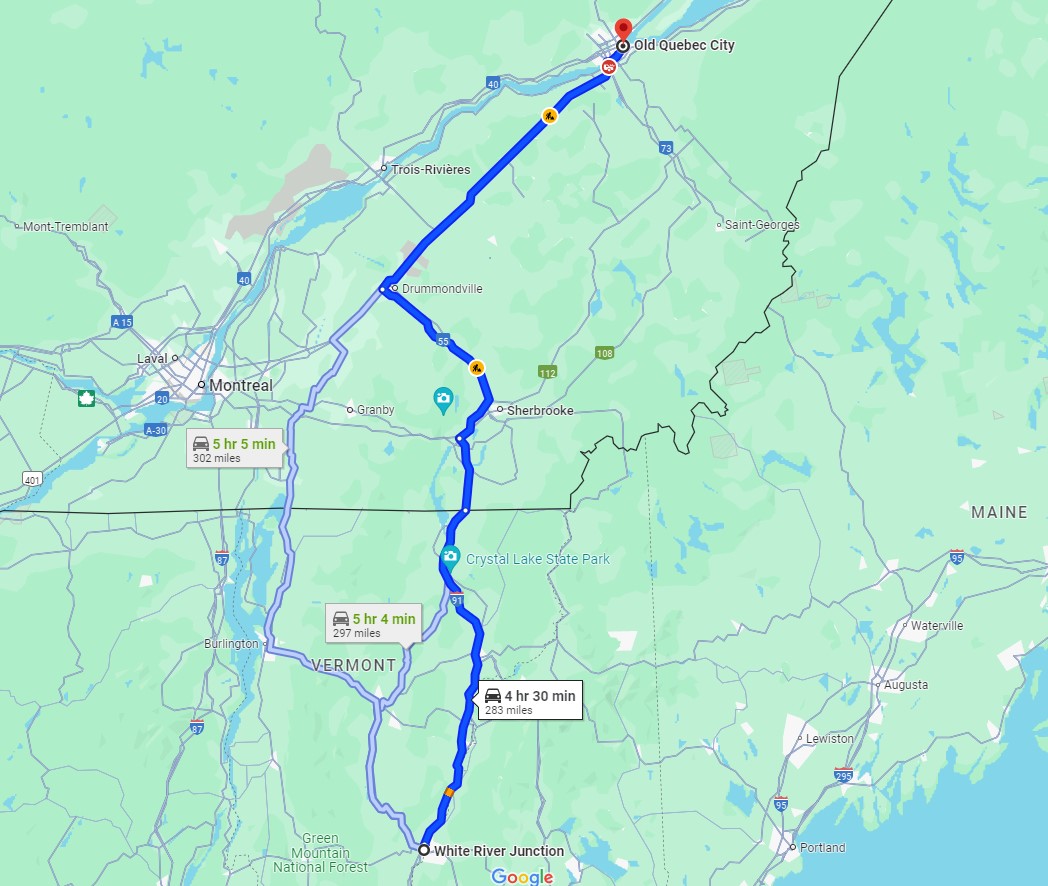
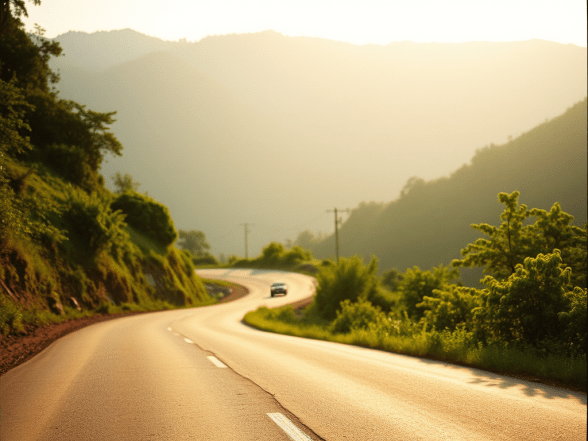
- Follow I-91 north for about an hour and twenty minutes to the hallowed border crossing near Derby Line (US) and Rock Island (Can).
- A brief comment about border crossings; we tend to get nervous heading into the US. With armed border patrol and agents that ooze with personality, asking questions in a way that make every possible answer sound suspicious, it’s not a comfortable experience. My fiancée was asked why it had been over 10 years since her last visit, as if she was on the lam or hiding state secrets. On the way back to Canada however, it was stereotypically polite; a gentleman rocking a relaxed French accent welcomed us home.
- One poor woman on foot made her way between the line of cars to speak to a border agent. I don’t reckon the answer she received was positive; standing at the window she pleaded for quite some time before ambling off around the corner.
- The highway there changes to Autoroute 55N. Continue past Omerville and Sherbrooke all the way to Drummondville.
- Merge onto Autoroute 20E, part of the Trans-Canada highway system, and traverse a 140 km gauntlet of towns named after saints you probably wouldn’t know: Saint-Cyrille-de-Wendover, Sainte-Eulalie, Sainte Janvier-de-Joly, Saint Apollinaire, Saint-Jean-Chrysostome, and my personal favourite, Saint-Redempteur (Sounds ominous…I told you it was the final destination 🙂 )
- Jump on Autoroute 73N and cross the St Lawrence River.
- Follow the QC-175 through Sainte-Foy-Sillery-Cap-Rouge until you see the walls surrounding the citadel of Old Quebec.
Old Quebec is a fascinating place; once inside the citadel, I had a sense of lurching back in time. The narrow roadways, short streets and dead-ends that surrounded common areas all fed into the allure. Below is the tourist map of the town layout including the waterfront. Those from Halifax on the east coast may recognize a familiar pointed configuration of the fort. The city walls extend along the top of the cliff to the right, with the land side guarded with gatehouse towers depicted on the left.
(Whilst typing the previous paragraph, I was distracted by, and continued trying to read the graffiti at the bottom of the panel. I think it’s in French, might start with a ‘5’ or end with a ‘Z’. Tilting your head doesn’t seem to help either).

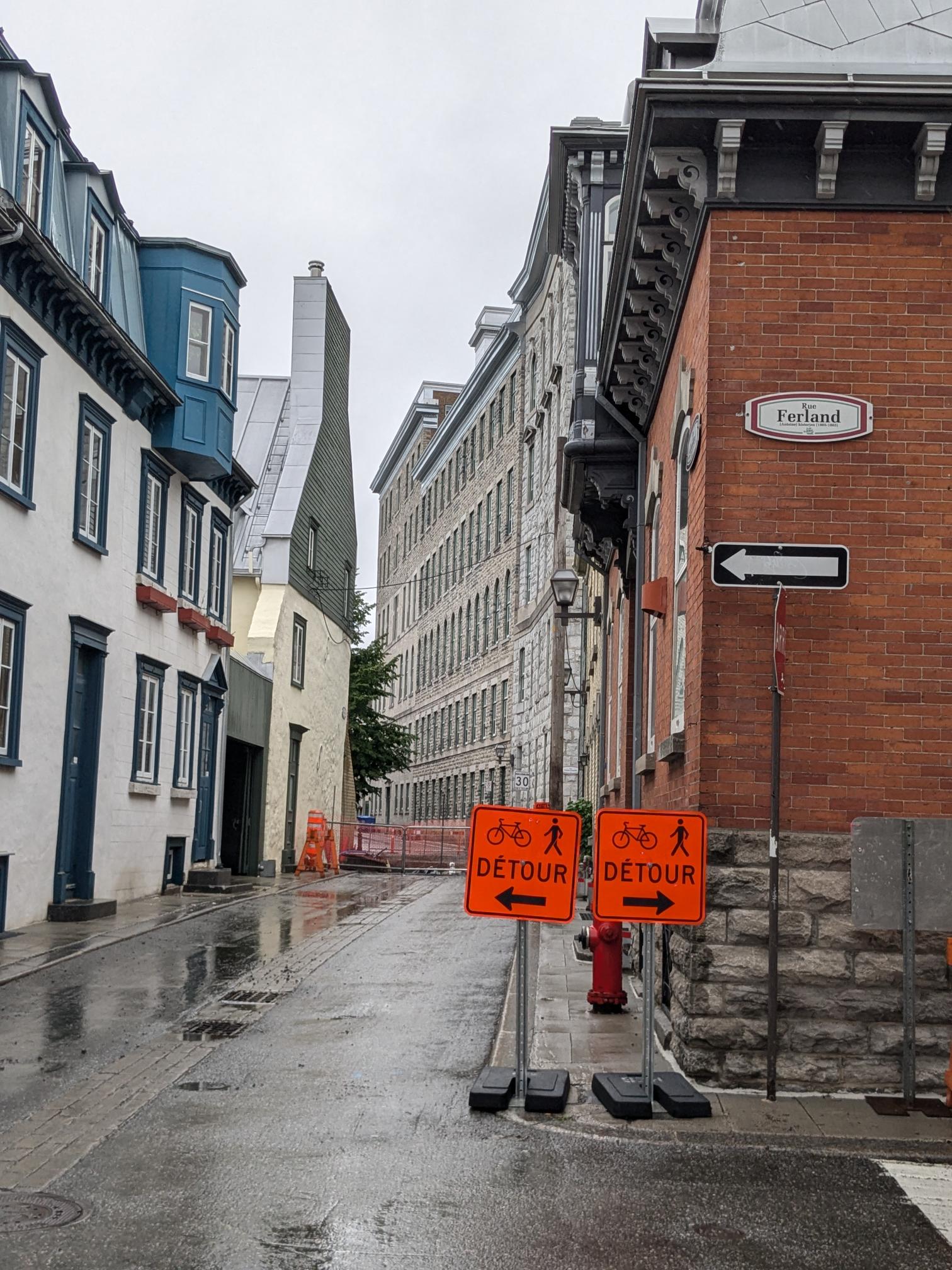
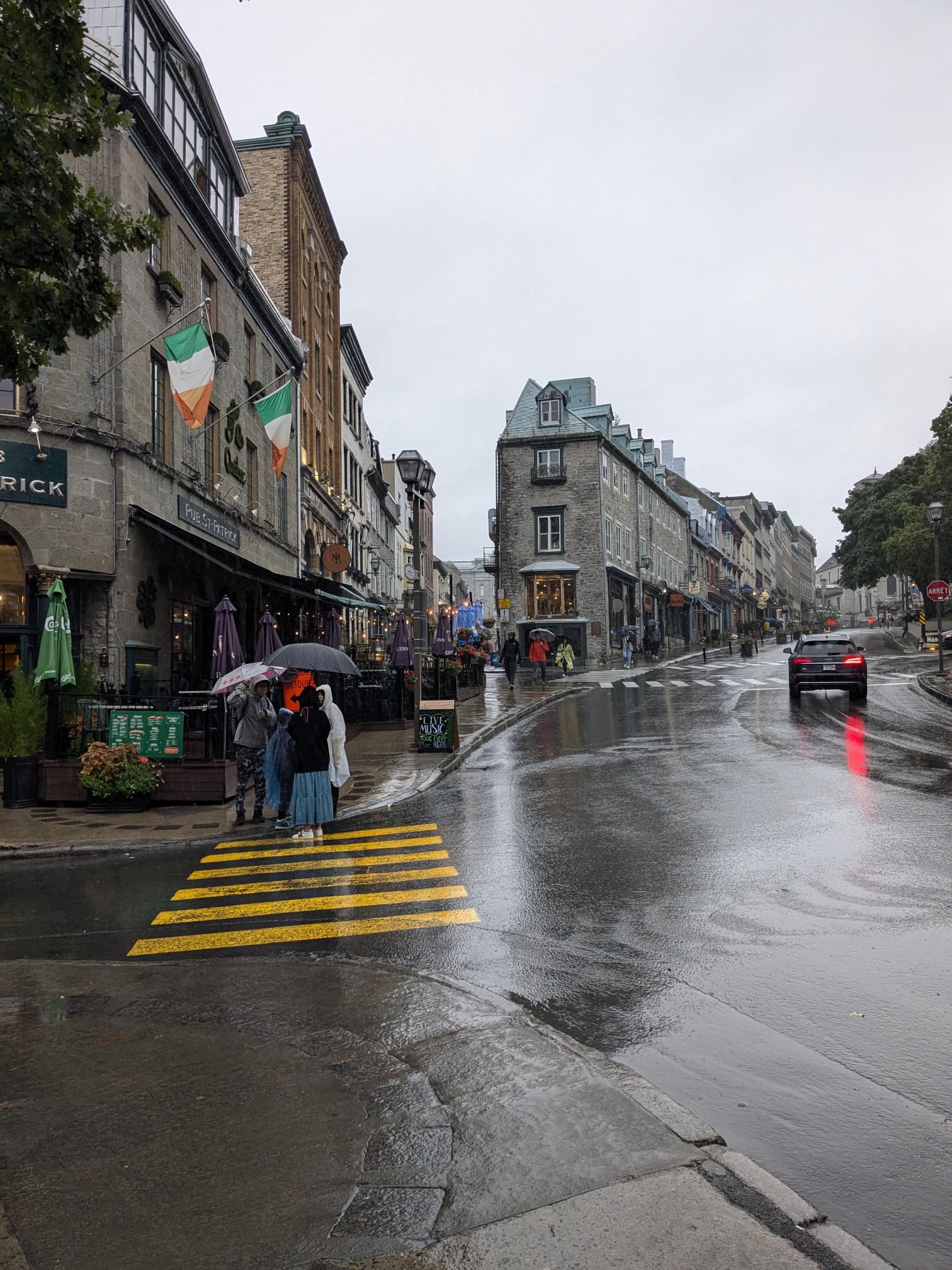
As we were in town for only two nights, it was unfortunate that one of them was very rainy. We walked around anyway, with my shoes soaking through almost immediately. At least with overcast skies, it allowed for some nice pictures of the shiny streetscapes. I found the detour signs amusing; they suggest that it doesn’t matter where you go, just don’t go straight.
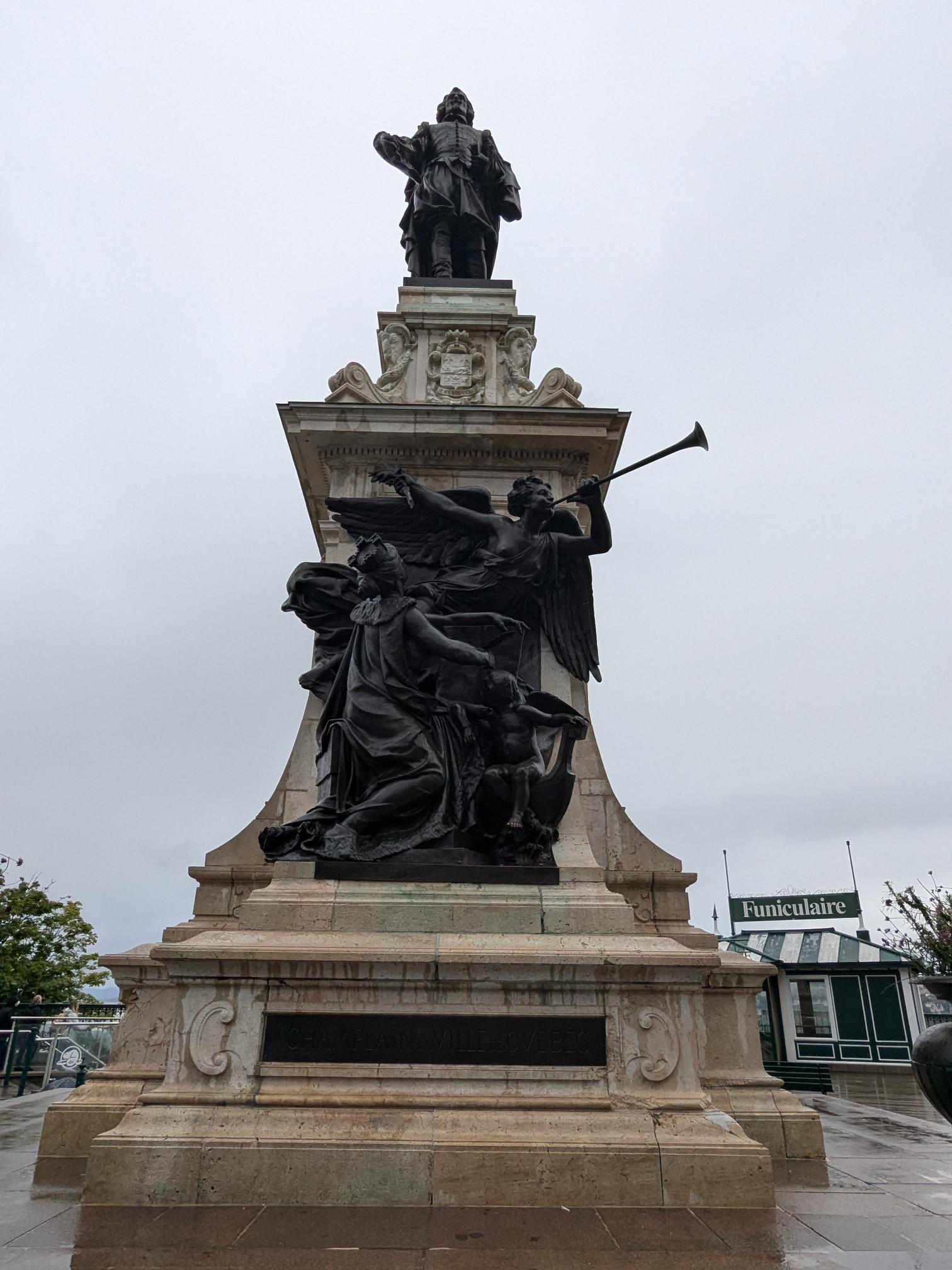

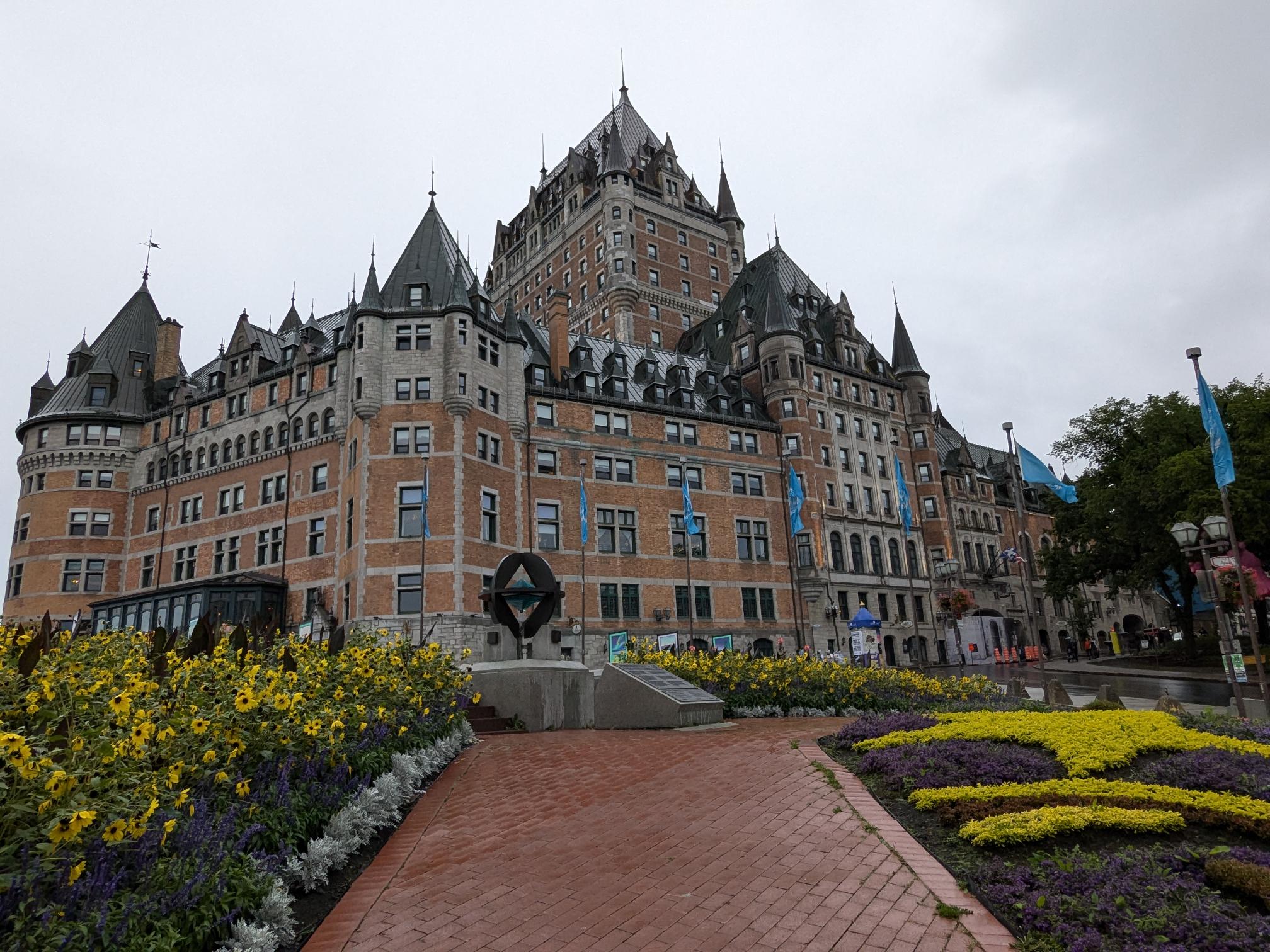
What would a trip to Quebec City be without a gratuitous photo of Chateau Frontenac? The hotel, operated by Fairmont, was built in 1893 by Canadian Pacific Railway at a time when rail was a prominent method of travel for the country’s affluent citizens. These grand hotels were luxurious in every way, replete with themed rooms, restaurants, and conference facilities. The Royal York in Toronto, and Banff Springs are other examples of the chateauesque style inspired by French Renaissance architecture of many chateaux lining the Loire River in central France. With the asymmetry, steeply pitched roofs, and often featuring ornate towers or spires, these structures are truly awe-inspiring.
Below left: The interior of the Notre-Dame-de-Quebec Basilica Cathedral. You may have caught the shot of the basilica’s street exterior in the gallery above. The inside is far more impressive; the detail of the arches, pulpit and stain glass that fill the clerestory windows is astounding.
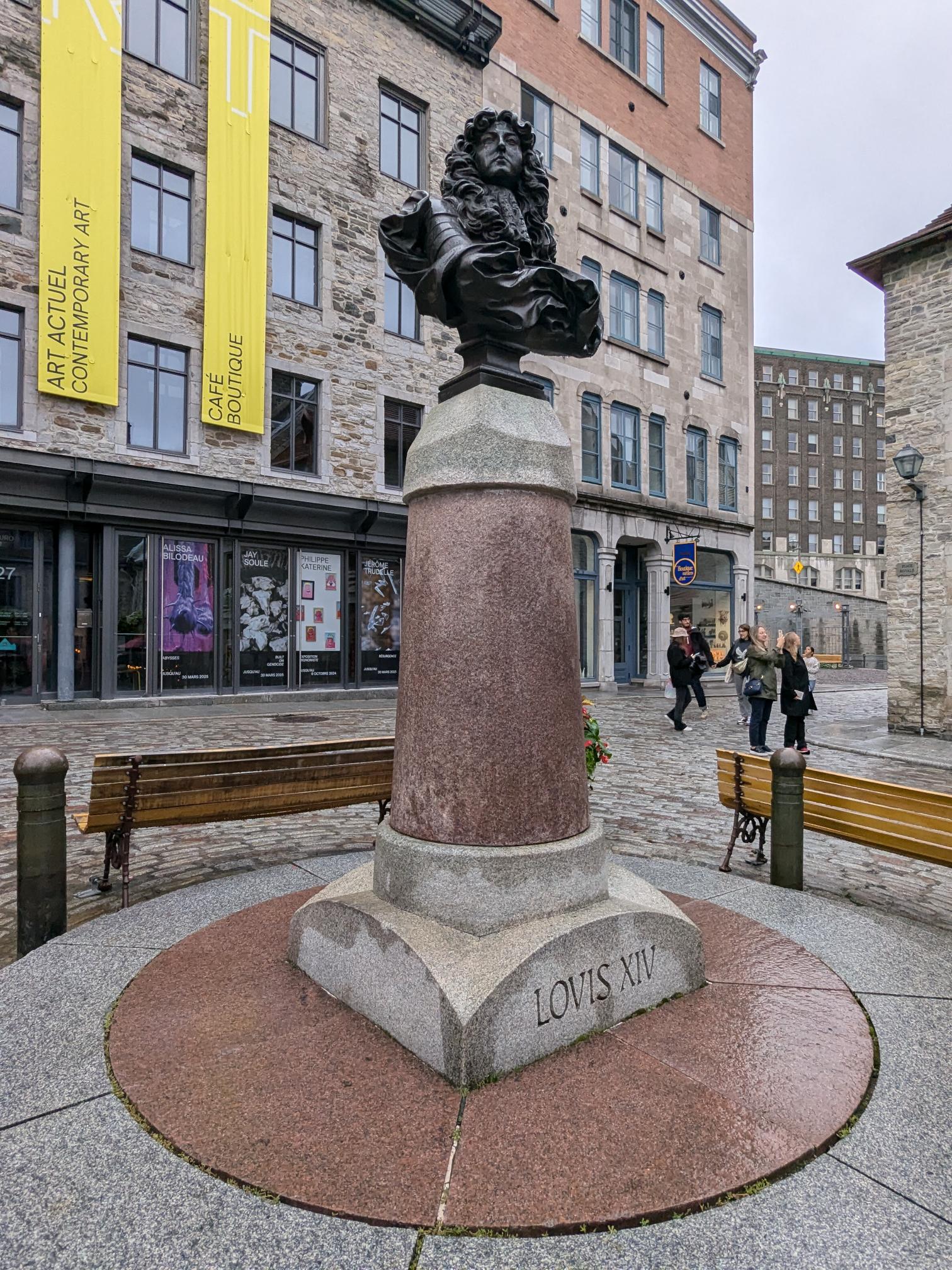
Below right: A bust of King Louis XIV, better known as Louis the Great or the Sun King. Louis holds a legacy of French colonial expansion in the late 1600s into the early 1700s. He is the record holder for the longest serving monarch of a sovereign state, at 72 years and 110 days (1643-1715). Number two is Queen Elizabeth II of England, with a reign of 70 years, 214 days. The main difference being that young Louis ascended at age 4 upon his father’s death; he did not assume absolute rule until he reached the age of majority in 1661. Apparently, he thought rather highly of himself. The statue below is one of at least 20 he commissioned during his rule, along with upwards of 300 formal portraits. He nurtured his image as the Sun King, or the centre of the universe “without equal”.

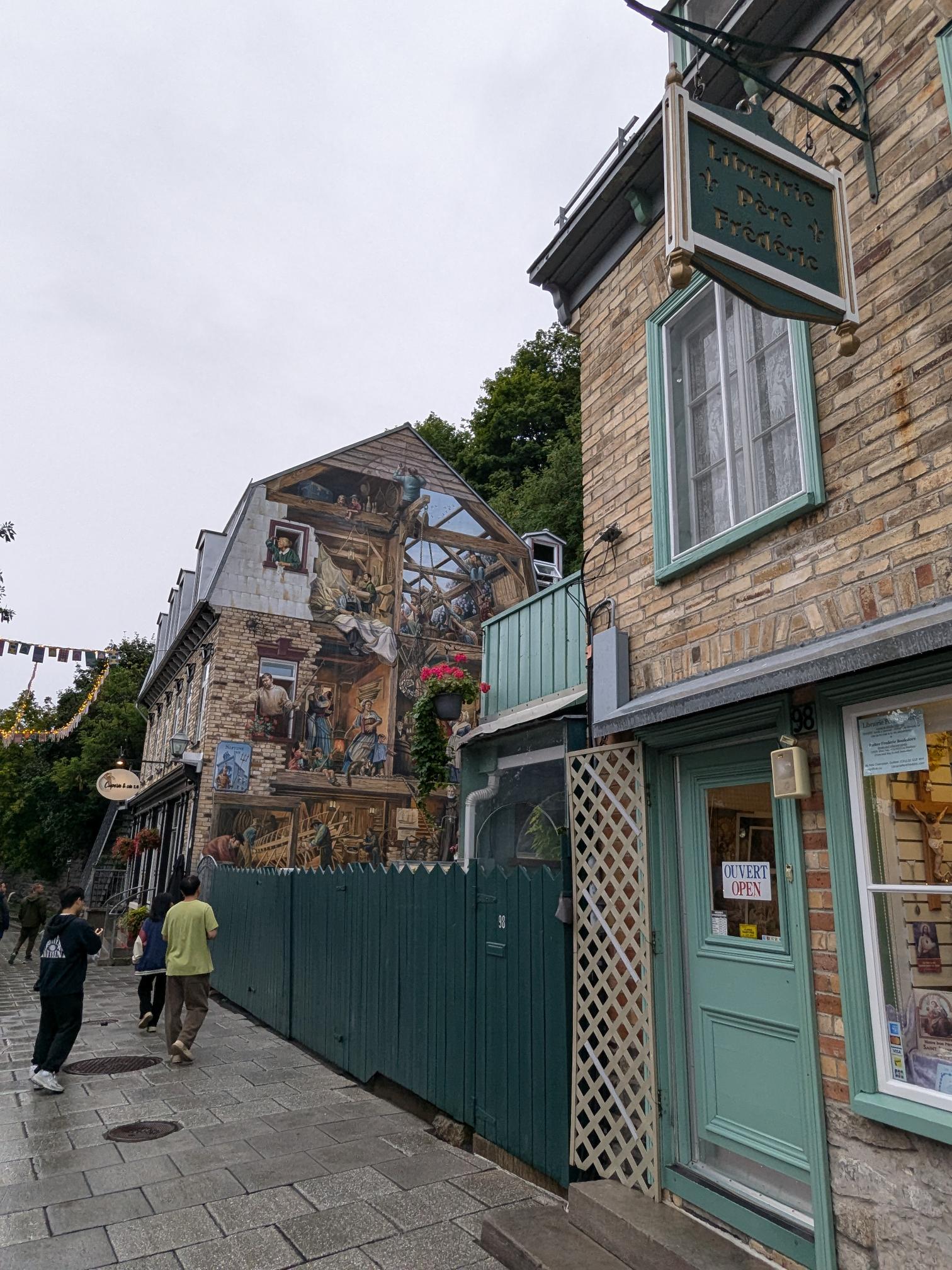
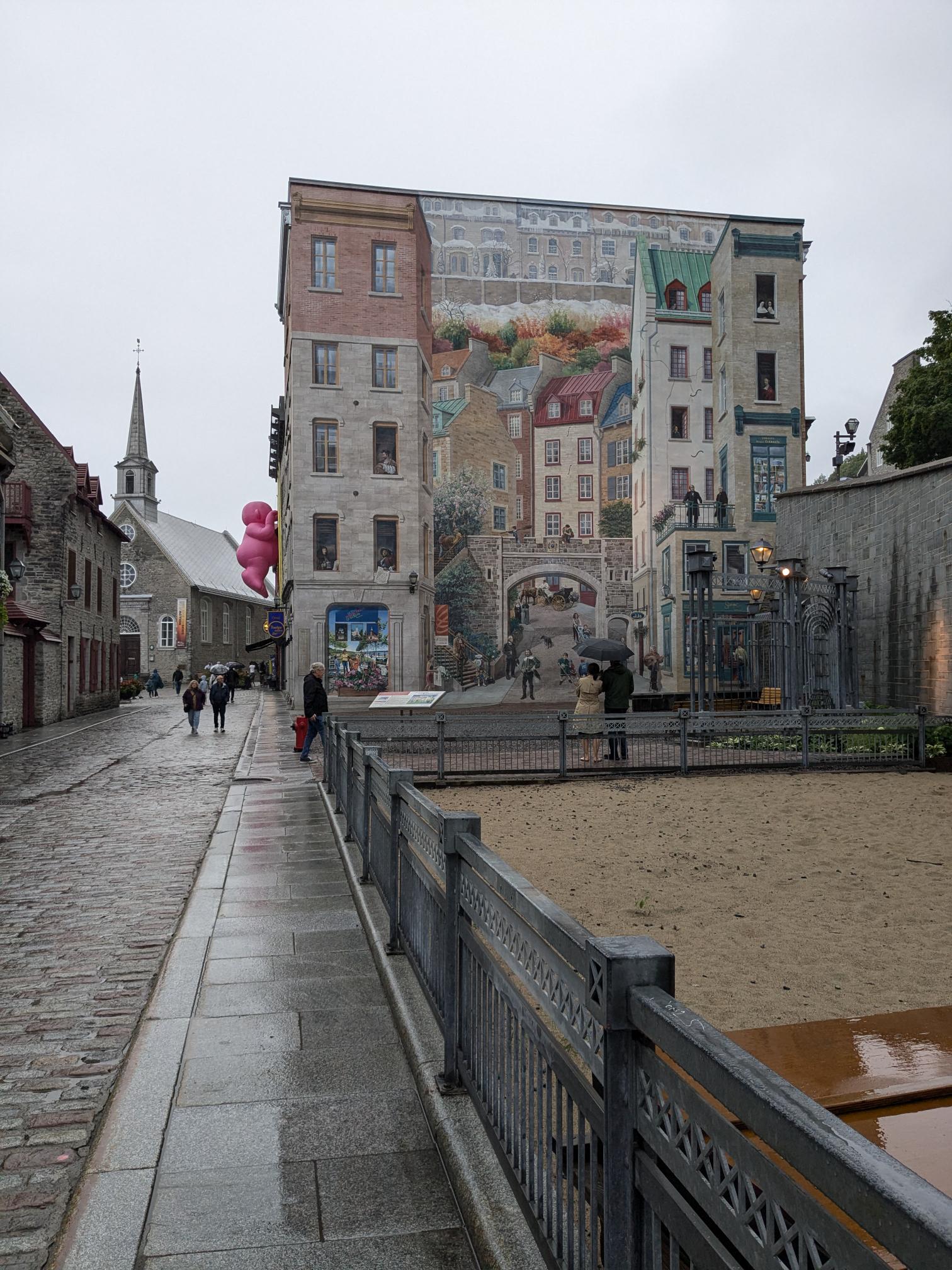
The sides of the next two buildings are full murals! In the second example, you would swear the left hand corner pillar and windows are real. The wet grounds divulge the fact the rains were still swirling; sans umbrella, we didn’t get the chance to properly stop and fully study these works of art.
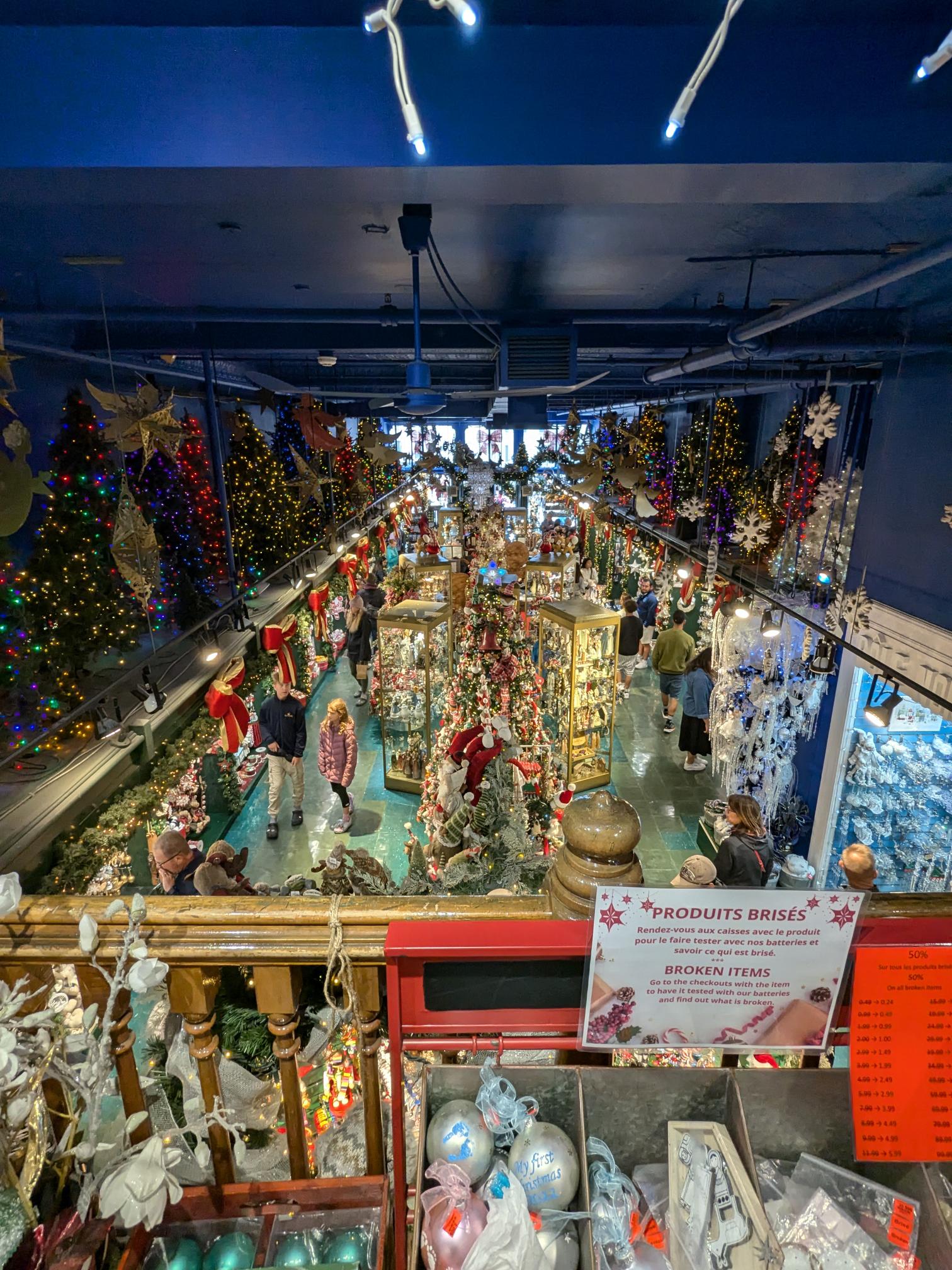
For our second day, the weather cooperated and we circled about to visit areas that we thought interesting from the evening before. One of the most fascinating was the Christmas Store, or La Boutique de Noel. If you are a fan of Christmas, the selection under this roof is incredible. Below is the view from the mezzanine, but it truly doesn’t do it justice. Every alcove, nook and cranny was full of ornaments, displays, figurines, and wreaths in every shape and size.
During our walkabout. gazing in shop windows suggested a heavy lean towards tourism; many stores featured standard Quebec-themed giftware or clothing. However, there were also plenty of high-end clothing boutiques and jewelry shops in every quadrant. There was one that stood out: Geomania. So much so, we bought souvenirs for friends and family back home. A geologist’s dream, there were displays and samples of mineral deposits alongside custom jewelry and polished stones. Each mineral they feature had its own section, with an entire room dedicated to a Jade museum, with stones mined locally in the province.
Also, there was this:
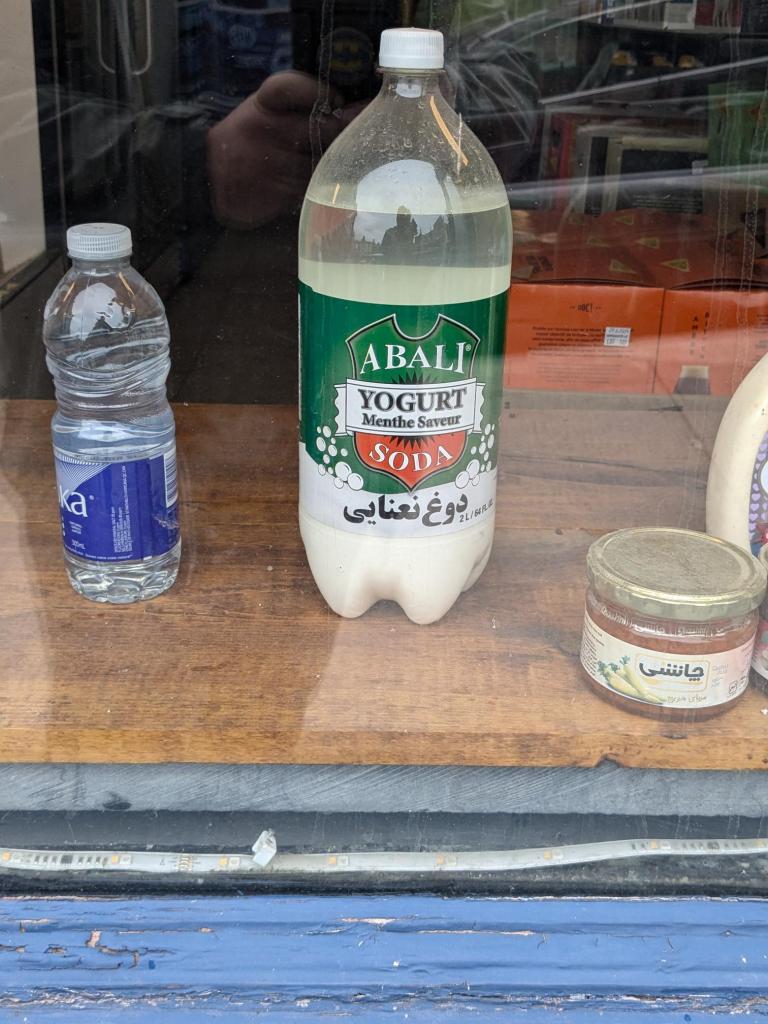
I’m sure folks were just sitting around the fire, contemplating the meaning of life and riffing on how yogurt was just so boring. Someone had an idea to add flavouring to it. Sure…vanilla, fruit, it’s all been done. Not so fast! Let’s add mint to the yogurt! While we’re at it, let’s add carbonated water to the mix and let it separate!
Surely, I jest. In fact, this beverage is called Doogh, a cold and savoury Iranian drink made of fermented milk that traces its history to Persian times. The word itself derives from the persian word for milking, dooshidan. It is the main Iranian drink to accompany meals.
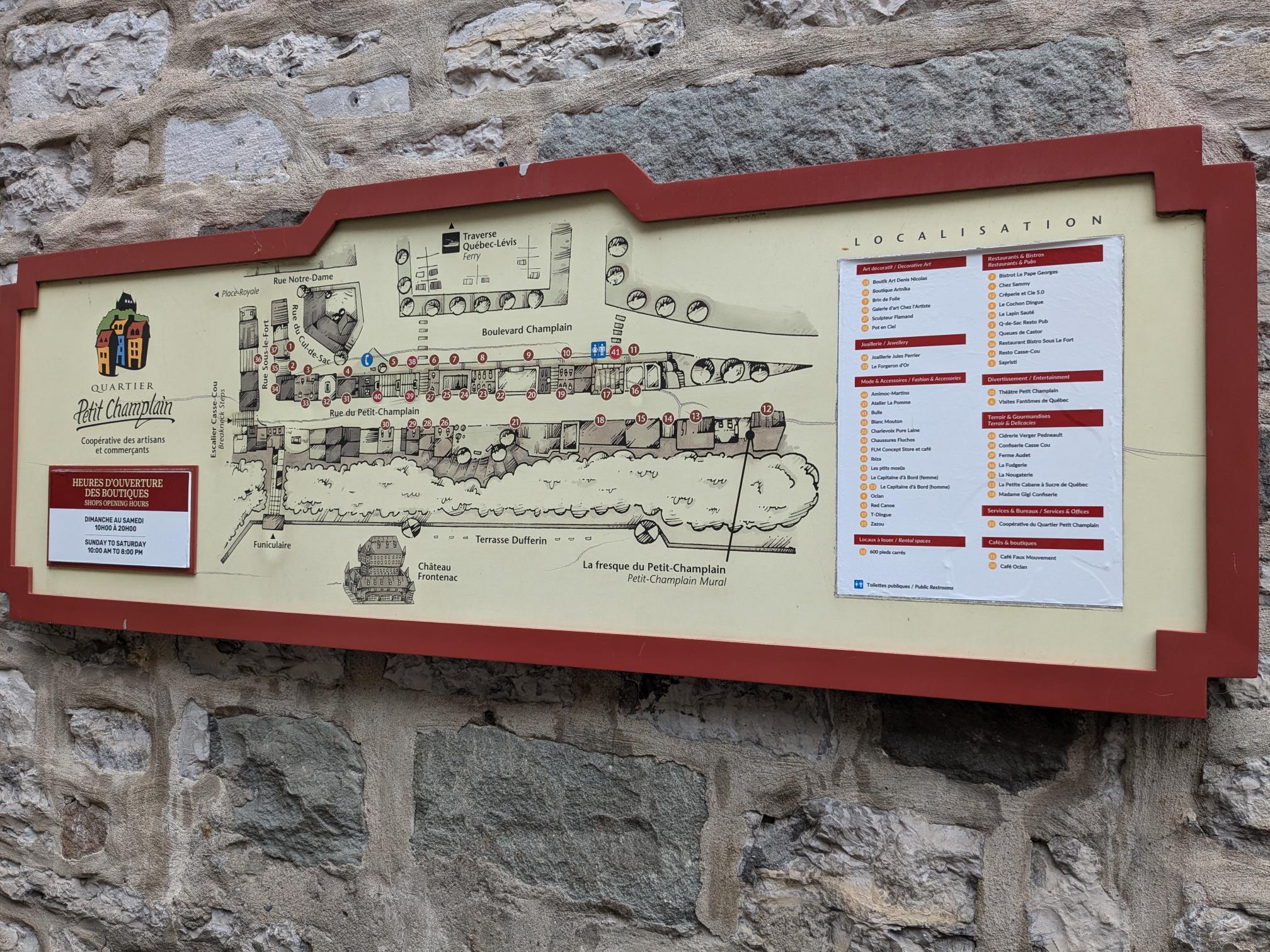
Descending the steps into Lower town, we reach the small commercial sector of Petit Champlain. Mostly a pedestrian area, there is a collection of 45 vendors to explore as part of a co-op. The layout is depicted below. You can tell the main street is rather narrow and it was densely packed. We stopped off for an afternoon snack at Pub des Borgia for a plate of yummy smoked meat nachos before perusing the shops along the strip. There were fudgeries, fashion shops, jewelry stores, art galleries, various coffee bars and restaurants. We didn’t eat at The Crazy Pig or the Sauteed Rabbit, but checked out the menus for fun. There was also a fashion store called FLM. Due to the family-friendly nature of this blog, I have decided not to post the sandwich-board sign that spells out “F*** La Mode” 🙂
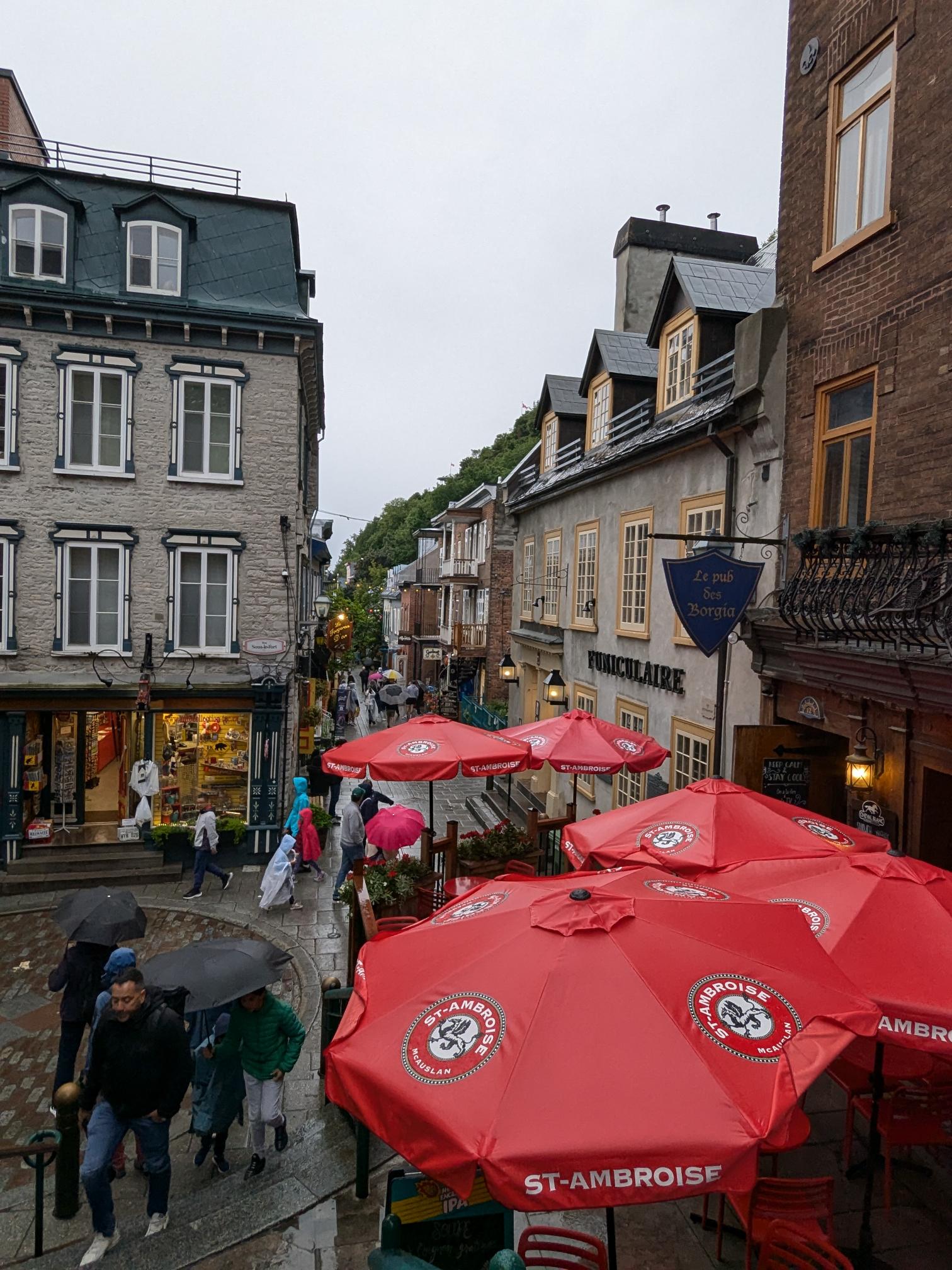
Below left: The view from the stairs connecting the upper and lower portions of town.
Below right: Looking up the street from the water towards the Funicular, a lift that rises about 60m on a 45 degree grade up the side of the promontory. The ride is barely a minute but a convenient way to travel the 20 storeys between Upper and Lower Town.

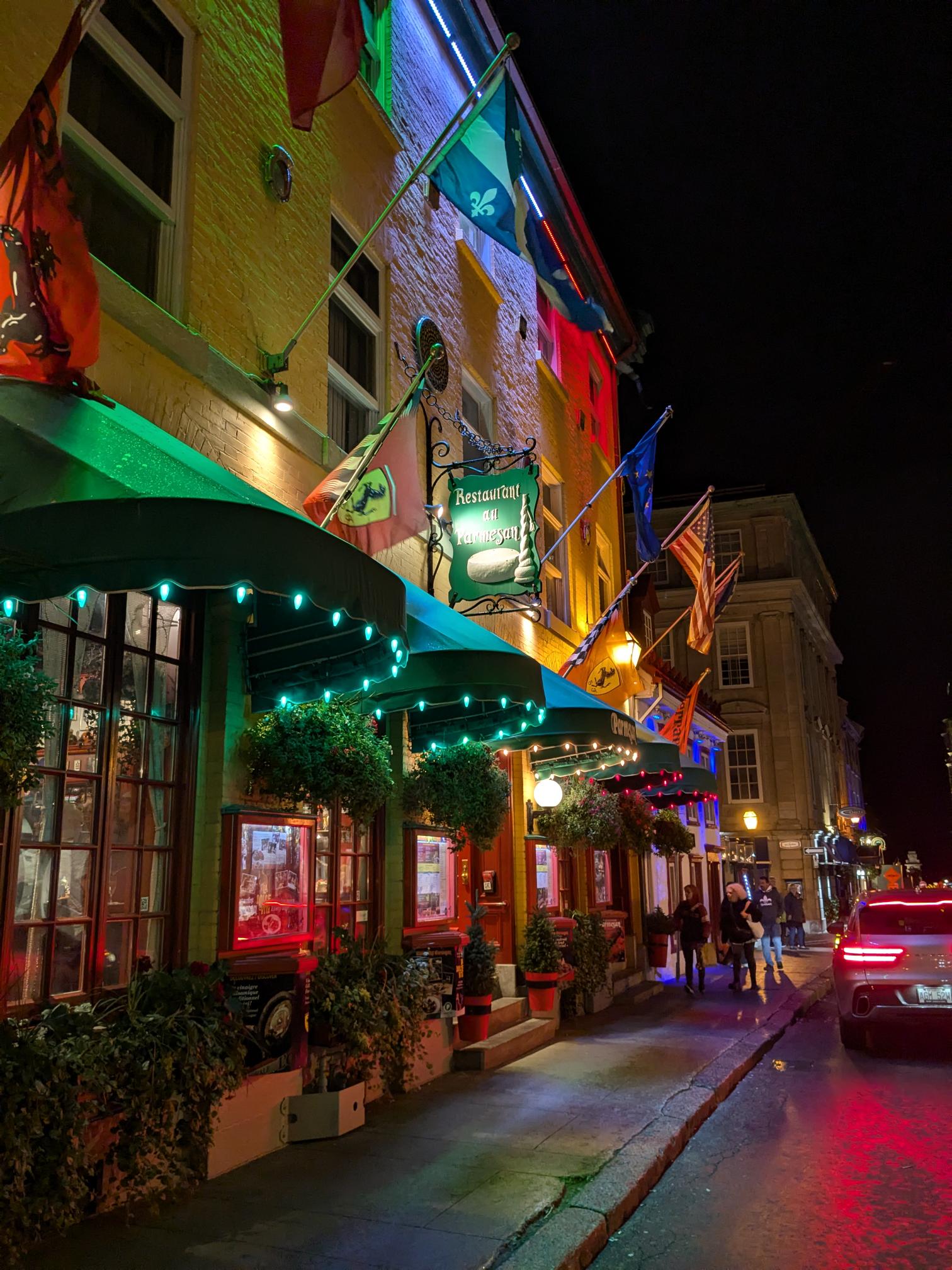
After an afternoon of shopping and tripping on cobblestones, we wanted something special to mark our final evening of the trip. Passing a few places on the walk, I decided to fall back to Italian food once again and made reservations for Restaurant au Parmesan. Only about a block away from Chateau Frontenac, the place was packed. Thankful for the reservation, we were seated in a side room where the noise level was decent. The molding across the top of every wall was chock full of liquor bottles and glassware. The bottles weren’t just the standard single malt variety you’d find in an Irish pub, but spirits from foreign countries in all sorts of fantastic shapes and colours. Every inch of wall was adorned with mirrors, decorative shields, and commemorative dishes. Adding to the ambiance, an organetto player circled the room playing Italian folk music. The food was decent, but pricey. I seem to remember having the rack of lamb listed as a house specialty, but it doesn’t stand out. However, the wine list was extensive and they featured some interesting desserts, including une Tarte au Sirop d’Erable (Maple Syrup Pie). I would recommend enjoying a meal here if you get the chance.
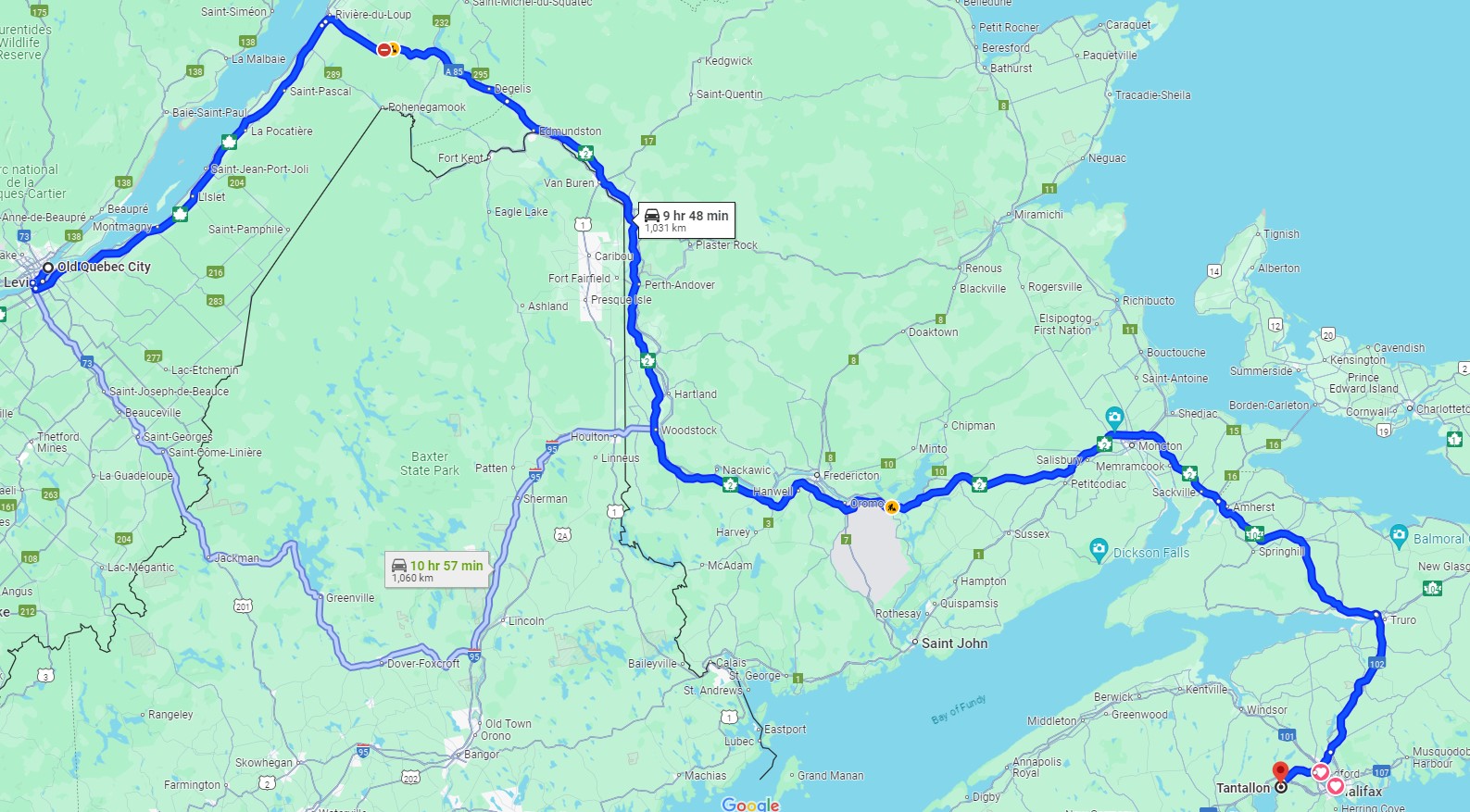
On the morning of Aug 22, we settled for the last eggs and a few remaining pieces of toast. Checking out of our AirBnB around 9 am, we embarked on the last 1000 km of our journey home, following the Trans-Canada along the St. Lawrence and into New Brunswick at the Edmundston crossing. Save for a biology break and a late lunch in Fredericton at the Rustico (driving through my dad’s old neighbourhood in the process), we took turns driving the 10 hours home.
During the long stretch in the car, I had plenty of time to think and reflect. The impact of this trip, at this time of my life, and with the people I love the most will stay with me forever. This odyssey represented more than a vacation, but an important point in time on my own personal journey. I will leave those thoughts for another day and perhaps another post!
Thank you for reading! It’s been a delight to share this experience with all of you.
Disclaimer: The views and opinions expressed in this article are those of the author(s) and do not necessarily reflect the official policy or position of any agency, employer or affiliation.













 PharmAspire