Potential Potential

I know you’re thinking, ‘Why the double-word title? It makes no sense and now my day is beginning with confusion. I’m going back to bed.’

It’s actually a combination of potential (verb – having or showing the capacity to become or develop into something in the future) and potential (noun – latent qualities or abilities that may be developed and lead to future success or usefulness).


Everyone has the potential to become an encourager. You don’t have to be rich. You don’t have to be a genius. You don’t have to have it all together. All you have to do is care about people and initiate. – John C. Maxwell*


How many people do you live with, or work with, or know in passing that have a penchant for under-performing or appear to be unmotivated? Your perception of them may be incorrect as their current behavior may not tell the whole story. We’re all slave to our egos to some degree, and the self-esteem we carry has a direct impact on our work quality and our confidence to produce results. If my boss applauds that our most recent inventory was spot on, everything that day seems a bit easier to get through. When I give a flu shot to someone afraid of needles and they exclaim that it didn’t hurt at all, I can walk out of the counseling room with shoulders back and chest out. On the opposite side, if I make a medication error and a patient expresses doubt as to my competency, my turtle shell will be waiting in the office as a safe haven. So perhaps those who seem lazy and unmotivated are actually terrified and have been doubting their abilities for so long that they refrain from really taking responsibility for anything.

The quote above speaks to encouragement. ‘All you have to do is care about people and initiate.’ It’s so simple in principle, yet difficult for so many people, especially the ‘initiate’ part. A lot of the time it’s because of the first part of the quote, ‘Everyone has the potential to become an encourager.’ It’s one of those circular arguments where you recognize that a potential encourager needs to be encouraged themselves to unlock their potential to encourage others. It’s quite a mouthful to say, but if you don’t have a mentor or colleague that reinforces what you do and pushes you outside of your boundaries, why would you be expected to do that for someone else, or even know where to start for that matter?

I have been fortunate to have family and friends support me through the wonderful highs and a smattering of lows. I dedicate my blog to inspiring members of the pharmacy community, and live my daily life according to the following mantra:


When you catch a glimpse of your potential, that’s when passion is born. – Zig Ziglar*


Whether it’s baking, singing, playing soccer, or identifying a drug-related problem that significantly impacts a person’s quality of life, finding what excites someone takes time and effort to encourage and cultivate. Once they catch that glimpse of what they like, and what they’re good at, it can open up doors they never thought possible. Maybe they are excellent at providing customer service and serve as a model for new staff. Perhaps they have a knack for technology and enjoy training others on a new computer system. There might be scenarios where someone has enormous value in the human-relations department due to their conflict-management skills.

I assume everyone has potential potential. Pharmacy assistants, pharmacists, regulated techs, department managers, all the way up to the executive levels have unexplored paths to follow. They may have the capacity to do more, see more, discover and develop skills they didn’t know they had. If in some small way, I can help shine a light on one of those interests or skills, having a front-row seat to watch a new passion grow is the most satisfying feeling I have ever experienced.


*Quotes courtesy of http://www.brainyquote.com/

Disclaimer: The views and opinions expressed in this article are those of the author(s) and do not necessarily reflect the official policy or position of any agency, employer or affiliation.
Broaching Breaches

The expectation of privacy in today’s world is becoming increasingly difficult. Everything is becoming electronic; online banking, online shopping, email lists and profiles built on computer system are common in every business nowadays. Pharmacy is no different. With the advent of the Personal Information Protection and Electronic Documents Act (PIPEDA), ground rules are in place for private sector businesses to collect, maintain and disclose any type of personal information contained in a database. Obtaining consent is essentially the gateway to collection;  if we are not able to collect, maintain and use the information for the purpose of filling prescriptions, it’s very difficult to  provide service, if at all. Having accurate allergies and diagnoses can definitely impact the appropriateness of a new therapy or dose change.

The issue of consent can be a minefield. For instance, the Personal Health Information Act (PHIA) in Nova Scotia doesn’t specify an age of consent. The individual must have the capacity to provide informed consent, that is to say that when given all of the pros and cons of allowing personal information to be used in a given situation, they  have a choice to provide that authority, limit the scope, or revoke their previous permissions. In 2008, the criminal code of Canada raised the age of consent in sexual matters to 16, with exemptions down to 14 and in some cases if two minors are involved, even as low as 12. This is important because pharmacists need to determine whether a protective parent should be included within a young patient’s circle of care. As an example, a new birth control prescription is presented by a teen, but her mom picks it up. It’s not always straightforward. The same thing goes for those suffering from mental illness or cognitive decline. A spouse or other family member may be a more reliable source of information when making clinical decisions, but the patient has every right to keep information from being shared with them.

Even with safeguards in place, breaches have happened and will happen from time to time. Faxes sometimes end up at the wrong office or two people with similar names pick up each other’s prescriptions. Nobody intends for these incidents to happen, but the reality is that systems can fail. Perhaps an address wasn’t confirmed or was misheard at pickup. Maybe a large order accidentally included someone else’s bottle during the bagging process. As mentioned above, a counsel session could be initiated with someone who is not within the patient’s circle of care. With expanded scope of services, pharmacists have a heavier burden to communicate any injections or prescribing activities to the primary care-provider. We may not necessarily have longstanding relationships with everyone that receives a flu shot, so while faxing is more convenient than calling an office, we are relying on the patient to specify their family doctor and the potential for error is real. It happens in the other direction as well. Our site has received patient profile requisitions from hospital units intended for other locations, or transfers intended for other pharmacies.

I believe we do an admirable job at upholding these responsibilities. Use of personal information is appropriate to properly advise and advocate for patient care and we’re about to receive more of it in the form of the Nova Scotia Drug Information System (DIS). Other provinces are in various stages of integration; examples include H-Link in Alberta, the Pharmacy Network in Newfoundland and Labrador, PharmaNet in British Columbia and Health PEI. They all currently feed data from institutional and community settings into a central database. While this endeavour is aiming to provide a comprehensive patient profile of all provided health services, it also poses challenges to maintaining privacy. More information will be available to more people in real-time. Applications for this information will be new to many users and perhaps mistakes will be made with security permissions and protocols. Perhaps a look-up with a misspelled name results in accessing the incorrect profile, and adding a care note that doesn’t pertain to that individual. Lab values may be routed to the wrong ‘Dr. Smith’ and communications end up at the wrong office as a result.

At the end of the day, we will continue to apply due diligence in all cases to protect and maintain the integrity and security of the database. The additional information will be available so we can make better, well-rounded clinical decisions for our shared patients. Connecting healthcare providers in community and institutional settings is a huge positive. We can speak the same language based on the same complete profiles. Frankly, many patients seem to assume we already have this access when caring for them, so when we finally do, let’s make the most of it shall we?


Disclaimer: The views and opinions expressed in this article are those of the author(s) and do not necessarily reflect the official policy or position of any agency, employer or affiliation.
Flu Shot Redux

Oct 19,2014.

The date has been bandied about for the commencement of this year’s flu vaccination season. Although the date may change slightly from this posting, Nova Scotia is ramping up for a robust campaign to exceed last year’s success. Pharmacies in the province provided upwards of 80,000 doses of the seasonal vaccine while physicians provided only about 18,000 doses less than the prior year. Interestingly enough many pharmacies, including my own, were late receiving supply or had only one injection-certified pharmacist on staff for a good portion of the fall/winter months.

Last year, performing injections was new for pharmacists here, but we got pretty good at it. In the time since, I’ve been keeping in practice with travel vaccines and have recently been in demand for the shingles shot as patients become more comfortable dropping in to ask about them. For a service so straightforward and quick (the act, not necessarily the pre- and post-documentation), people genuinely appreciate the convenience and most will happily pay any associated fees to avoid sitting in a clinic waiting room.

I’ll be the first to confess that I’m not that excited about needles; whether I’m giving or receiving a shot, my feeling is quite neutral. I know there are plenty of practitioners who can give and not receive, or have a mental block when it comes to touching a patient. The sight of blood in any amount may not be on your daily agenda but the reality is that pharmacists have proven we can fill a large care gap…a care chasm as it were. An at-risk individual may be stopping in for a blood-pressure medication refill and perhaps receive a shot at the same time. A family of four with two kids under the age of ten come to pick up a few things on the way back from a matinee and now they’re no longer influenza carriers for Christmas dinner with Nan. A pregnant woman’s fears about harming her baby will be allayed.

The point here is that I see the value in providing the service to those that want it. Many members of the public are against flu vaccination. That is their right, and I have no interest in putting anyone on the defensive. I DO however want to be available to anyone who is eager to protect themselves and will pass the word that we’re ready and willing to provide for their family and friends if they are so inclined. Waiting on our first lot of vaccine is making for suspenseful week with the multitude of phone calls we’ve been fielding, so the demand is there. Signs are up and clinics are being planned. It appears we’re going to be receiving Agriflu, which is pre-filled 0.5mL of convenient, time-saving goodness. To be sustainable, our approach will be to treat any request for a vaccination no different than an acute medication for a patient; wait times may vary depending on the time of day and the volume we’re processing. These are duties we will carry out as best we can with the flow of the day.

You can bet that as long as the flu vaccine supply lasts, pharmacies will be instrumental in finding deltoids to receive it. When the season passes, we’ll be ready for the travel rush of winter.

Emergency kits inspected? Supplies ordered? Forms printed? Staff primed on intake? This year, it looks like we’re all ready to rock.

Just remember to save a shot for yourself.


Disclaimer: The views and opinions expressed in this article are those of the author(s) and do not necessarily reflect the official policy or position of any agency, employer or affiliation.

Thoughts on Technician Regulation

Guess what? There are some marked differences between hospital and community pharmacy.

As the blueprint for pharmacy practice transitions across the country, these two working environments really serve to highlight those differences, especially from a training and orientation standpoint. My personal experience in hospitals over the past decade is pretty much non-existent. I have be on some site visits, and have marveled at how the dispensaries were run. My curiosity led me to question how such large teams can become so consistent in their discipline to complete tasks. Like cogs in an assembly line, if one piece gets shifted or removed, another is prepared to repair or replace without missing a beat. Through my observations and discussions, it has got me thinking: in many ways, hospitals are holding back technician regulation because they’ve been too effective in their integration of current assistants to roles requiring more training and responsibility.

Let’s back up a bit…

Here in Nova Scotia, hospitals operate under different regulations than community-based practice. I’m sure this is true in many jurisdictions. Health professions can collaborate freely within the confines of the hospital and have some flexibility to re-define roles in response to new service demands. Tech-check-tech processes were introduced in the hospital long before it was being used in long-term care or community settings. Specialized technical roles had non-pharmacists in charge of sterile preparations, stat-box management and unit-dose dispensing. Dispensary managers are often former technicians that are now administrators, developing and enforcing policy and procedure, while overseeing site-specific training modules that may require upwards of 6 months to complete.

This has allowed pharmacists to spend more and more time in clinical, collaborative practice and minimal time in the actual dispensary. Many full-time positions are entirely clinical in nature, opening the door to take full advantage of approved expanded scope services (i.e. – lab test requisition).

Therein lies the rub: technician roles have been leveraged so well that regulation doesn’t appear to have the same dramatic impact on hospital technicians as it would in a community setting.

As a community pharmacist in both retail and previous long-term care environments, I can see the potential in the investment towards tech regulation to free up pharmacist time. The main difference is that we need the regulation in place to take advantage of some of the opportunities before us, where pharmacists aren’t the ones who primarily verify a completed prescription or compliance packaging, and instead can spend more time injecting, reviewing medications, and documenting interactions with patients. Hospitals were able to integrate those functions without the formal regulations in place, and are thriving as a result.

In closing, although it’s taken a long time, regulation is finally here. There are excellent people in pharmacy assistant positions that are stepping up to support the pharmacy profession. The glass ceiling is cracking and is primed to shatter. A new profession, with new leaders being recognized as the professionals they are, will push us to the next level.


Disclaimer: The views and opinions expressed in this article are those of the author(s) and do not necessarily reflect the official policy or position of any agency, employer or affiliation.

The Payback of a Little Charity

A couple weekends ago I hopped on my bike and pedaled close to 100 km in my 4th MS Bike Tour.

The distance is one thing, and the need for a good pair of padded undergarments always provides ample fodder for tour volunteers and non-riding supporters. This year turned out to be one of the best yet, though very different than my previous three. This difference was for reasons that didn’t occur to me until afterwards.

We rode from the Windsor Exhibition Grounds to Acadia University under a comfortable, cloudy sky. After the first day, my new team settled into the residences at Acadia for an afternoon of swimming before the annual banquet. After dinner, we ended up back in our rooms to have a wobbly pop or two. During the evening, the dozen of us took turns explaining our reasons for being there. All were insightful and inspiring, and topics always involved family members or close friends with multiple sclerosis. Some were diagnosed at a young age and deterioration ran the gamut from slow (decades) to rapid (<2 years). You may get the impression that I can sometimes be rather long-winded, and you would probably be right. I’ll share the condensed version here for the sake of brevity:

Thirteen years ago, a mentor and friend began an MS Bike Tour team in support of a longtime colleague’s wife. I was aware of the team, but saw it as a cause with which I didn’t connect. I knew little about the disease, the progression, or the treatment options. Year after year, along with her wife, she would invest time in planning fundraising events, theme designs for the team picture, and seeking corporate donations. Each year she would ask me and I’d hedge. Perhaps I had plans the weekend of the event, or I didn’t have a decent bike, or even worse I was in terrible shape and wouldn’t survive it. It all changed when I found out my aunt was afflicted with a mild form of the disease. As kids, sometimes playdates with the cousins were cancelled for unknown reasons. Come to find out that her fatigue would persist for days or weeks, and she would be unsteady on her feet. At this point, my excuses rang a bit hollow and I made up my mind to commit to the cause.

2011 – The Cycledelics were celebrating their 10-year anniversary on the tour. Our black t-shirts were printed up as tuxedos with red-bow-ties. We sported top hats on our helmets and twirled canes into the banquet hall. I was 30-lbs overweight and my cargo shorts didn’t have a lot of padding. On the way back, I couldn’t stand to sit back on the seat and couldn’t walk for the better part of a week, but I made it.

2012 – We had a cowboy theme this year: plastic ten-gallon hats on our helmets and rodeo shirts. We rode into the banquet on hobby-horses. I bought a better bike, some padded shorts, and lost 20 lbs. Raised more money than the previous year and I wasn’t the last rider on the course this time.

2013 – ‘The Swarm’: dressed as bees, with bright-yellow t-shirts and electrical-tape pinned in place for stripes. We all wore headbands with antennae and big-round shades. This time the banquet attendees had us buzzing around their tables. All in good fun. I felt I was in the best shape of my life to date. I had trained for the 3-months before and my riding partner and I flew through the course. Even managed to do the extra 38 km loop on day 1 for good measure.

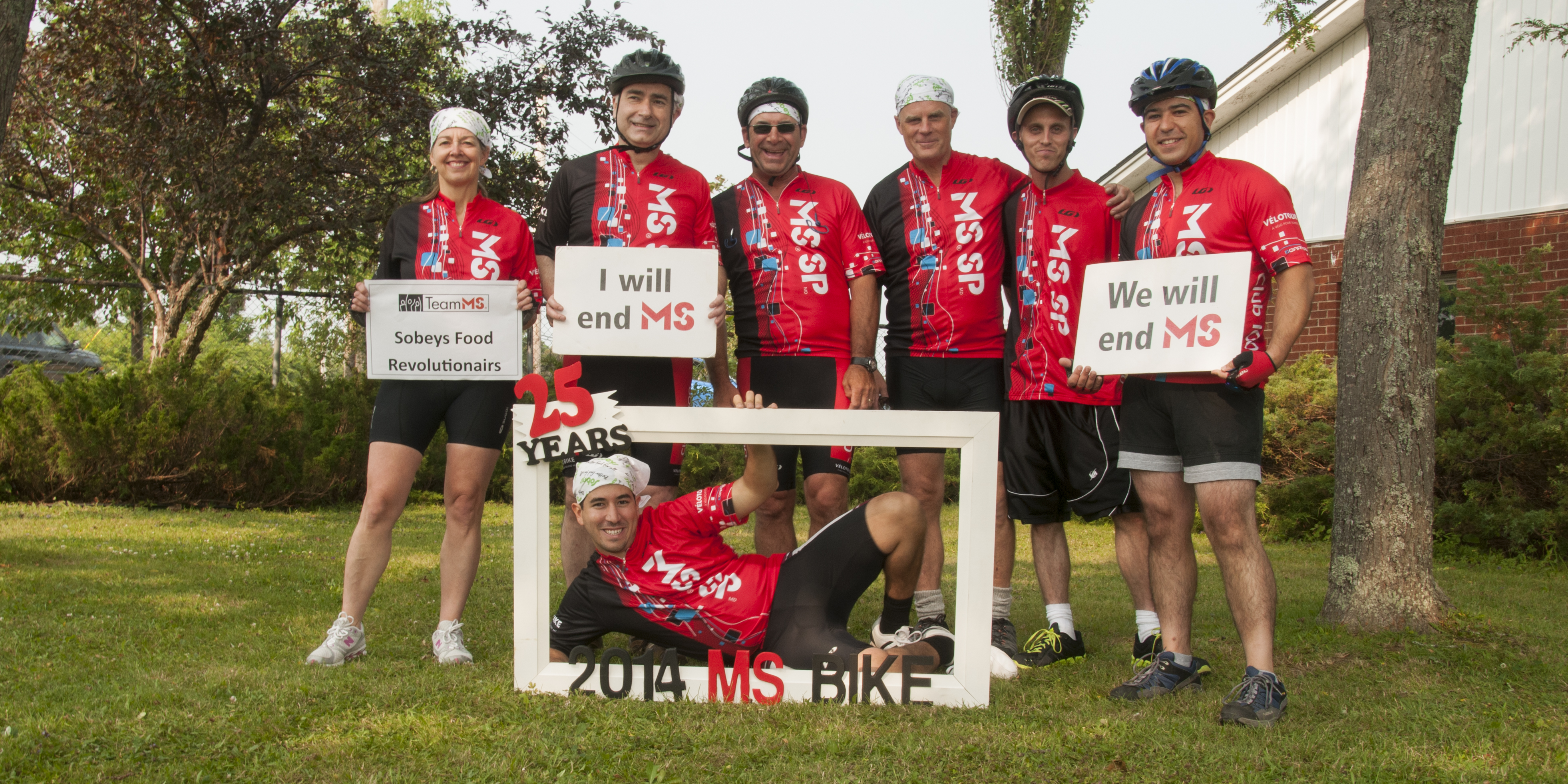
This brings us to 2014, and I had since taken on the pharmacy manager role at Sobeys. I was connected to a store manager in town who had also ridden on the tour and wanted to start up a corporate team. We brought 5 stores into the fold and pooled our riders fundraising efforts with a goal of $10,000. We had store BBQs, a poolnight, and two paintball afternoons. We had casual days for staff, we sold MS oatmeal cookies from the bakery, and sold 50/50 tickets. We went on to raise almost $14,000 for the fight against MS. Not too bad for year #1.

2014 MS Team

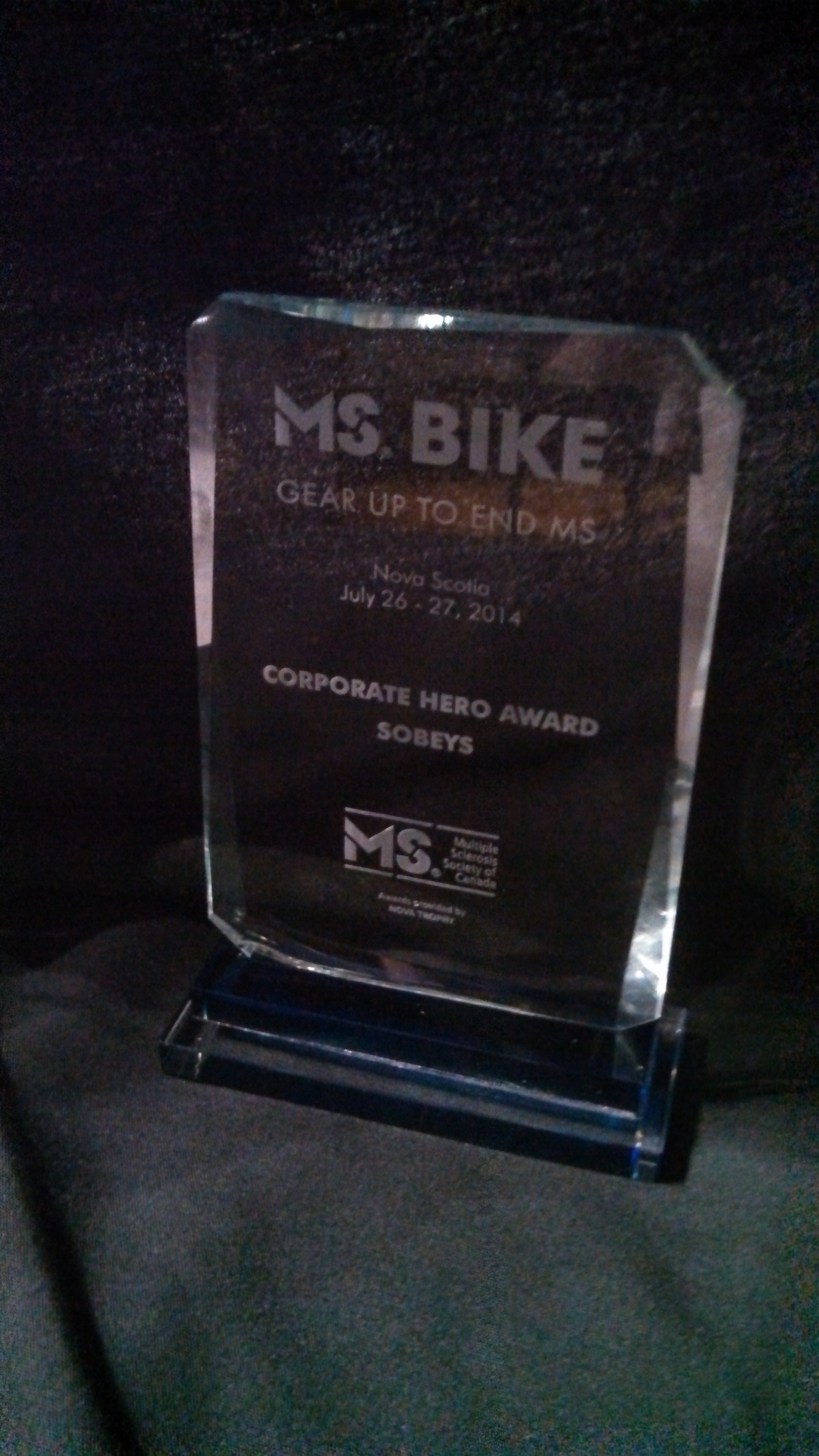
I was apprehensive leading up to the ride. I had hoped to see members of my former team but wasn’t aware of where they were staying or who would be attending. This new team was a hodge-podge of riders from different stores, and none I knew well. My fears were allayed once we arrived at Acadia. My former team members were two floors down in the same residence and we hung out exactly the way we did in previous years. I even ran into a friend I had not seen in well over a decade cutting fruit in the cafeteria (Nice to see you HB). Our team was the newest of the three corporate teams on tour and managed to take home some hardware for our efforts:


Corporate Hero Award 2014-MS  Team Cheer Award - 2014-MS

Our cheer was to the theme of Gilligan’s Island. Not everyone in attendance got the reference.


So why was this the best one yet? I didn’t train as much, and had a pair of dead legs 3/4 of the way through, so that wasn’t it. I doubled my previous personal best in fundraising, but that wasn’t it either.

This was the first tour that I felt like a leader. New riders would come to me for their preparation and itinerary. MS Society staff called me by my first name. Most importantly, I had a new appreciation for the passion and dedication shown by the staff, volunteers along the route, and the 330 riders who participated. People were giving of their time and energy to help others not because they were forced to, but because they wanted to. It’s contagious;  we spent the whole night planning fundraisers for next year’s event. I know I’ll be recruiting some of you to join me on the 2015 ride.

When it’s all said and done, we really did pull together to make a difference in the lives of those suffering from MS. Drum-roll, please…

MS Tour Total 2014

Makes it all worthwhile, doesn’t it?


Disclaimer: The views and opinions expressed in this article are those of the author(s) and do not necessarily reflect the official policy or position of any agency, employer or affiliation.

Quick…To the Lab!!

I can’t help it. Every time I see the word, ‘lab’, it evokes images of smoke, arcing Tesla coils, boiling green flasks, and crazy Christopher Lloyd hairstyles.

When a pharmacist in A community setting refers to lab values, they’re usually asking a patient directly to ascertain whether all the bases have been covered. More often than not, the patient does not know what they’ve been tested for, let alone the actual LAB values. Fortunately, With our newly expanded scope of practice, coupled with the incoming drug information system, these awkward conversations with patients will soon come to an end.

As clinicians taking on broader responsibilities, performing lab requisitions is one more unknown that we need to navigate. There are numerous applications that scream for pharmacist intervention. A1C and INR are at or near the top of the list, but I suspect that many other practical uses are waiting to be discovered.

In speaking with a close RN friend of mine, she thought pharmacists having access to lab values was a wonderful idea, but brought up a number of pitfalls that we’ll need to consider when we officially begin:

– Shall we be authorized to request all tests, or be restricted in some fashion through a permit system?

– The cost of a test.

– The appropriate monitoring frequency for a given test.

– Are tests to be used to aid diagnosis or strictly to monitor existing therapies?

– Who owns the test results and the right to intervene if necessary?

– What is the lab capacity in a given jurisdiction?


There is a fear that once able, pharmacists in community settings will want to create baselines for all patients. Some of these will be absolutely reasonable and will fill gaps in patient care. Others may be open to interpretation and potentially create conflict with other care providers. I offer a couple of examples from my time in long-term care. At the time, the Nurse Practitioner and I routinely spent a couple of hours reviewing 50 patient charts at a time ahead of meeting with the nursing staff and medical director of the 200-resident facility where we worked.

1) B12 – We performed a focused medication review on patients receiving vitamin-B12 injections, noting that many did not have blood counts requested since their admission years prior. Out of a dozen patients, we were able to discontinue six of them that showed upwards to three times therapeutic levels. Although the long-term toxicity was not much of a concern, it was one more injection to track (and thereby eliminate for the time being) and in two of the cases, blood counts had not rebounded due to a relative iron-deficiency that had gone unchecked.

2) T4/TSH – As per accreditation standards at the time, we aimed to have a complete medication review performed with 6 weeks of admission. Often patients discharged from hospital were relatively stable on their current regimens, and needed time to get acclimated to their new surroundings. Usually at this time, we determined monitoring parameters for bloodwork and obtained baselines if the file was incomplete. During one session, we decided to review all patients taking thyroid hormone and discovered that some residents had not been screened in years. Many were frail and drawing blood was difficult, but we didn’t see that as a reason to stop monitoring. Almost all required a dosage adjustment and corrected some previously unexplained symptoms due to hyper or hypothyroidism.

It was not always easy. One of the stumbling blocks was the impact to workflow on Thursdays. Blood was normally collected in the mornings and shipped to the lab in the early afternoon. This of course added some extra work that wasn’t always easy to plan. Another was the attending physician’s apprehension in having us discover an issue that was missed or ignored due to a plausible reason. He would then need to possibly defend his/her action/inaction to us, nursing staff, and perhaps even the resident or their families.

I guess it will be another learning experience for all of us, but I look forward to the day when we can ask and receive a clearer picture of an individual’s health from a lab test. I’ll even bring my own Tesla coils.


Disclaimer: The views and opinions expressed in this article are those of the author(s) and do not necessarily reflect the official policy or position of any agency, employer or affiliation.

Honouring a Colleague

On these pages last September, I referred to the unfortunate passing of one of our own pharmacy community. Karen Zed was someone who has had an impact on my practice for my entire career. Working with the same company since before graduation, her visibility within the profession as a mentor and advocate was evident through her work with our Nova Scotia regulatory body as well as the Dalhousie College of Pharmacy.

My working relationship with Karen developed over the years. I worked first as a student, then as a relief pharmacist, before transitioning into management roles. With each step, I was reminded of the respect she commanded from her peers. We may not have always agreed with her opinions, but they carried weight and inspired healthy debate. Although I did not know her well on a personal level, it was obvious how much she thrived when precepting students, interns, or anyone with an interest in pharmacy. She was staunch in defending her practice site as a true ‘real-world’ experience; you learned by doing, by making mistakes and fixing them, all with an eye towards the patient above all else.

In the 10+ months since, I have been lucky enough to be appointed as secretary of our pharmacy alumni division at the university. With Karen being taken away so suddenly, there was an appetite to celebrate her contributions on a grander scale. That is why the Dalhousie College of Pharmacy Alumni Division (DUCPAD) is pleased to announce the annual Karen Zed Spirit of Community Pharmacy Award. This award recognizes students who share Karen’s passion for community pharmacy as both a place to learn and to provide caring support for those in need of our medication expertise.

Details on how to donate to the award fund may be found in the June 2014 issue of the DUCPAD Dispatch, or by following the link below:

http://alumniapps.dal.ca/giving/giving.php

Rest in peace Karen. May your spirit endure in the next generation of community pharmacists.


Disclaimer: The views and opinions expressed in this article are those of the author(s) and do not necessarily reflect the official policy or position of any agency, employer or affiliation.

Spring Has Sprung…Finally

As I was out mowing the grass today, I began to think back to the lawn metaphor I used to describe why I write this blog. I do it to help make my own environment a little bit better. Hopefully I can help others do the same.

As a tip of the mortarboard to new graduates entering the profession across the country, I’d like to re-visit this metaphor one more time.

I give you: new practitioners – the grass seeds of pharmacy.

Are you still reading? Work with me on this.


Grass seeds start out as tiny things but with huge potential. They require water, sun, and a little TLC to germinate and grow. We may need more of them in rough patches: brand new lawns, places where planters have been or where weeds have gotten out of control. However with some nurturing and protection from the elements (birds, digging animals, intense sun, etc.), they can grow into a beautiful, resilient lawn.

New grads are just like grass seed. And not just any seed, let’s get the coated seed that supposedly absorbs ten times the water and grows anywhere. They too hold a large amount of potential but need some coaching and moulding, especially at the beginning of their careers, to truly become great practitioners. New graduates are ready to make their mark on the profession. Bringing new energy and a certain naivete to current practice environments can be a real advantage to filling clinical service bare patches.

If your new clinical leads are faced with too much exposure without proper coaching, they too will burn, and it may take awhile to reverse the damage. I’m sure most of us have performed a med review and stumbled upon a concern justifying a recommendation to a primary care provider. Unfortunately, these recommendations aren’t always well-received. I’ve heard horror stories where physicians refused to share lab values or provided snippy replies to reasonable recommendations.  The most extreme case involved a patient taking advantage of minor ailment prescribing in Nova Scotia. Unfortunately it ended with the physician threatening the patient by asking them to choose between them and the pharmacist. This kind of salvo can be a blow to even the most seasoned clinician, let alone someone who is green (pardon the pun). On the bright side, these cases are becoming exceedingly rare as other professions recognize benefits of the new contributions we can make.

Coaching and support doesn’t need to come only from the manager or supervisor. It should be a complete team approach, with every clinical success, from identifying new ways to help, to appointment bookings, to follow-up being shared and celebrated.

So here’s to a greener lawn! Grow a robust clinical patch. Your yard, and your work environment will be a source of pride to share and show off. It’s amazing what a little water can do.


Disclaimer: The views and opinions expressed in this article are those of the author(s) and do not necessarily reflect the official policy or position of any agency, employer or affiliation.

It Comes in 50 Shades Apparently

A few years back, I was hosting a segment of our yearly 2-day orientation session for new pharmacist hires to the company. Most were new graduates but some were coming to us from other provinces and/or chains.

I was aware that a certain book was making the rounds at about that time and somehow my improvisational skills led me to drop the title with respect to the new expanded pharmacy scope. To my ‘surprise’, at least 3 people in the audience were in the midst of reading this book and were justifiably confused (though intrigued) by my seemingly random tangent. Although pharmacy is an exciting place, it seemingly pales in comparison to the plot of a story I should have spent more time investigating.  Now, I have never read the book and understand it to be a wholesome story of two people that meet and enjoy going for coffee, holding hands and don’t-you-dare-leave-this-book-laying-around-anyone-under-18.

After about 30 seconds, folks started reaching beneath the tables to gently pick their jaws back up from the floor. Queue the giggling. I enjoyed the mid-morning giddiness myself.

My point was that pharmacists, in a general sense, are used to having set rules to follow. Now every profession has rules in the form of guidelines, regulations, acts, or policies. We also have best practice memos to further help direct and support us as individuals. These documents are vital to minimizing liability as practitioners while stressing public safety. Those rules prior to the legislative changes meant we had our comfy room in the healthcare house; the boundaries were established and many scenarios had played out countless times. Black, meet white. Now, if somebody came to the door of the pharmacy room and invited you out, then you would have a taste of collaborative practice and it seemed like a treat. It was like being allowed to eat at the big-kids’ table at Thanksgiving; an experience you’ve waited for and look forward to the next time it happens.

So enter the blueprint of pharmacy and changes to pharmacy acts across the country. We now replace the walls to that comfy room with strips of yellow duct tape on the carpet. Now you can see the hallway, or venture into the next room without needing approval. You know where you used to spend all of your time, but your space got a whole lot bigger. Needless to say, each scenario with medication reviews, prescribing, administering, or ordering blood tests is new to everyone, and therefore virtually impossible to predict. Becoming a clinician means a certain degree of trial-and-error, and judgement calls based on the best information possible. There may not be a tidy ‘right answer’ or a similar situation on which to build.

As we gain confidence in our worth and abilities, many pharmacists may completely leave their yellow outline and settle in different areas of the healthcare house. They may join travel clinics and vaccinate full time, or perhaps pharmacists may liaise with physicians’ offices to perform medication review consults in their offices. They may become more visible and independent in rural communities as they perform minor ailment and emergency prescribing services.

In each possibility, and for each and every pharmacist delving into said opportunity, there will be fifty shades. You will be making decisions and backing them up with gusto. You will be challenged from time to time, but so is each and every health professional out there.

Embrace the grey. Explore the new rooms. Make yourself at home.

Disclaimer: The views and opinions expressed in this article are those of the author(s) and do not necessarily reflect the official policy or position of any agency, employer or affiliation.

Out of Bullets

“We offer flu shots, but have run out until the middle of next week.”

Unfortunately, my site is far from the only one parroting these words ad nauseam this past weekend:

http://atlantic.ctvnews.ca/n-s-pharmacies-having-a-hard-time-keeping-up-with-flu-shot-demands-1.1637675

In this article, it states that 60,000 people have been shot…er…vaccinated by their pharmacist in Nova Scotia when that number was expected to only be around 20,000. In addition, 435,000 flu shots have been distributed. That number represents 47% of the population, which puts NS in line to be the most vaccinated province in Canada. Those are some impressive numbers.

The first frenzy took place mid-Oct with media advertisements and statements from public health. Due to an administrative hiccup, my site had one pharmacist out of three with the authority to administer injections so we had to be creative with scheduling. Still, we managed to exhaust our initial supply and applied for another distribution. Then, the fever died down (pun intended). Things went quiet over the holidays with only the occasional inquiry. Then we get thrown a curveball from our sister province Alberta:

http://www.cbc.ca/news/canada/calgary/alberta-flu-cases-spike-5-deaths-confirmed-1.2482027

Not exactly a happy New Year to be sure.

Needless to say, this was a scary item to read online or hear on the 5 o’clock news. People reacted and started coming out in droves. When physicians’ offices began running out, pharmacies were the place to go. We had families calling from 45 minutes away to see if we had supply and offered the service. In saying yes, often the following question was “where are you located exactly?” People who had so far resisted getting vaccinated had their minds made up to receive one. Parents were bringing in their kids (5 years and up) and weren’t leaving even if it took a bear hug from mom or dad to control flailing limbs. It was pretty intense at the dispensary last week managing these requests. That is, until we burned through our relatively small supply and started to turn folks away.

Reports indicate that the flu season is only expected to peak in February and we’ve already begun to see a spike in positive influenza tests across the country. The FluWatch report issued by the Public Health Agency of Canada up to Jan 4 notes that cases are being reported in a higher proportion of adults 20-64, which is a change from last year. You can find the full report here:

http://www.phac-aspc.gc.ca/fluwatch/13-14/w01_14/index-eng.php

That last link took me awhile to digest. At least the graphs were varied and pretty-looking.

All in all, I believe we can surmise that pharmacy has strongly impacted awareness and access to the flu vaccine so far in our first season. Now, I say this with the caveat that the season is not over and final vaccination rates are not yet available.  Incorporating an injection service into our current processes is new, and it’s unpredictable, but I have to admit it’s been satisfying. Congratulations to all of my fellow colleagues who took the plunge and are embracing this new public health service with fervor and professionalism. If you’re like me, the overwhelming feedback from patients has been supportive and appreciative.

On that note, a quick story from Friday night…

A family of four from quite a distance away called to ask about having their kids vaccinated. One was 5, the other was 7 and their family doctor had no vaccines left. Once they arrived over the supper hour, I prepared the syringes and laid out the supplies. I had not uncapped the needle when the tantrums started. A boy and a girl were both convicted in the fact that whatever was going on was NOT happening on this night. The parents were worried that supply wouldn’t be there if they had to return and as it stood, I was down to about a half-dozen at that point. There were tears, and kids are slippery when they want to be. However, with a little patience, I was able to follow through without incident even though I wondered about them ever wanting to see me again. Five minutes later, the mom and a now sheepish little girl approached. The conversation went like this:

Mom: “What did you say? Did you want to tell him what you just told me?”

Girl: Hides behind mom

Mom: “She asked that if next year Dr. xxx isn’t able to give the shot again, would she be able to come see you?”

Me (in full blush): “Of course! You did very well.”

I found the rest of the night to be a bit of a blur 🙂

I hope we get our next allotment soon…

Disclaimer: The views and opinions expressed in this article are those of the author(s) and do not necessarily reflect the official policy or position of any agency, employer or affiliation.