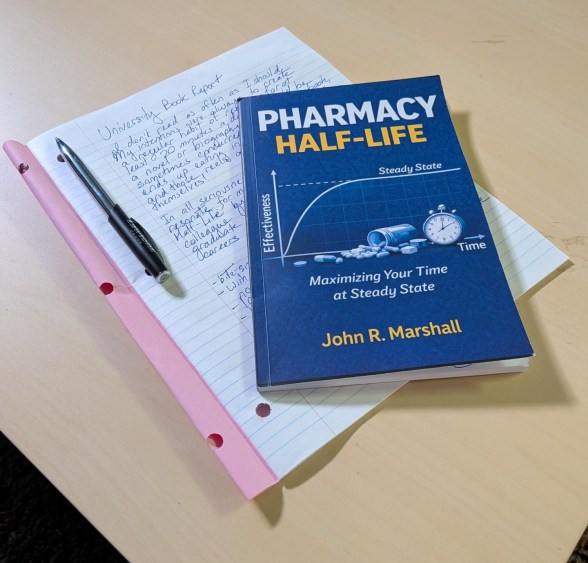
University Book Report – Pharmacy Half-Life

Ah, university…

My world of over a quarter-century ago. Back when adulting was new. The uncertainty and angst of a promising career delicately balanced with muted excitement for seemingly limitless opportunities! The late nights (for study of course 😉 and emerging social connections that have persisted to this day. Memories of notable professors and student personalities could fill up pages like a yearbook time capsule. Did I mention the procrastination?! Oh my yes, the wasted time we spent… Before the TikTok days, I was a beast for housework, but only when I had a big lab assignment due. Midterm exam tomorrow? What a lovely time to re-watch the Sixth Sense and hunt all the spoiler moments I missed the first time through.

That’s why I’ve titled this piece as a call-back to the days absorbing information through text was a full-time job. I was always better with conventional didactic learning as opposed to self-taught facts and concepts. Audio and visual cues were essential in my ability to recall and react to questioning. However, as I age my appreciation for the written word has deepened. Being able to peer between the lines to infer and incorporate lessons into my own experiences is a skill developed with experience and a reflective curiosity.

The messaging is familiar because the man is familiar. Our careers have plenty of parallels, from our education, our relationships and our career ambitions. He is passionate about life: his family comes first, followed by a insatiable drive to empower people through coaching in sports as well as his extensive pharmacy work. Reading Half-Life was akin to sitting across from him, feeling the warmth from a fire crackling in the hearth, and receiving one of the many spirited pep-talks he could deliver off-the-cuff. Even hearing his voice in my head as I flipped through the pages, there was something different…something more thought-provoking than usual.

The book itself is a very approachable read. There are 10 chapters of individual topics, each only about 3-4 pages in length, perfect for bite-sized chunks of wisdom. Each begins by offering a famous quote or example accompanied by personal anecdotes describing his journey of discovering how to thrive in the pharmacy profession. At the end of each chapter, there is a quick summary entitled ‘Positive Impacts’ that leaves the reader with a probing question. I found myself pausing between chapters to think about my own life and career.

My favourite chapters are 5) Leadership vs Management, and 8) Where Sport and Pharmacy Collide: Your Ideal Performance Mindset (IPM). The former explores key differences between organizational roles that are often seen as synonymous, when in fact there may be stark differences upon assessing cultural vs administrative functions. The latter introduces the reader to the concept of identifying their thought-process when performing at their absolute best, and nurturing behaviours to maintain that mindset in the face of external factors.

The prose is conversational, and comes from a vulnerable place; the author has lived within the pharmacy sphere for 25+ years and has gleaned valuable insight on how an individual can seek their own job satisfaction.

These are lessons I wish I’d known back in those university days. I would be fascinated to hear feedback from pharmacy students ready to make their mark on the profession. Very early on their journeys, have them think about leadership and how it can shape their careers:

  • How to develop the traits of a leader and to nurture those traits in others.
  • How to seek out and help build strong teams.
  • Using the Ideal Performance Mindset to avoid negative spirals.
  • How to be a good support, boss, peer and teammate
  • Reinforcing WHY they chose pharmacy

Make no mistake, there are nuggets that may apply to any person at any stage of their professional life. In fact, many of the concepts are certainly not just reserved for pharmacy at all.

In conclusion, I suggest picking up your copy today, either as an electronic or paperback version. I keep mine on my desk as a reminder of where I’ve been and where I still want to go. Pharmacy has given me so much in terms of opportunities to grow and network, but finding that steady-state has not always been easy. Balancing work and family can often feel like you’re following a GPS that is constantly recalculating, taking you in many directions at once. Sometimes all it takes are the words of a trusted friend and mentor to keep your inner compass from spinning when life decides to shake the table.

I’m honoured to call JohnR such a friend. I’m proud that he decided to share his wisdom in an effort to help others.

Lastly, I hope my report deserves a good grade!

Disclaimer: The views and opinions expressed in this article are those of the author(s) and do not necessarily reflect the official policy or position of any agency, employer or affiliation.

First Aid

It was time for my renewal for standard first aid (SFA) and Cardiopulmonary Resuscitation (CPR) so I registered for the 2-day course and completed my certification last week. This is a requirement to perform injections, but also an expectation as a health professional in the field. Every workplace location should have a trained individual on site at all times.

Is it just me, or does the training seem to change every year?

My first foray into first aid was to earn a badge as a cub scout. One of our group leaders was a trainer with St. John Ambulance and I recall it took place at someone’s house. There were about a dozen of us around the age of 8-10. I only retained a few items from that session: the constant warning of the graphic videos they could have shown us, how to tie a tourniquet, and just how scared to death I was to be confronted with a true first aid situation.

There was so much to remember. During the demonstrations where someone would have to take charge, we all looked at each other with eyes as wide as dinner plates. Almost everyone forgot at least one aspect of the primary survey (introducing yourself as a first-aider, determining multiple casualties, removing hazards, etc.). When manipulating limbs for splints and bandaging, the wrong hand placement led to drops or contortions that would probably do more harm than good. For the CPR component, we would disagree on timing of breaths or whether to do chest compressions first. This was well before the Good Samaritan Act so there was hesitation for fear of doing the wrong thing in the wrong order.

Since then, the training seems to have evolved to be more of a ‘stay calm and collected, assert control, and remember that you’re trying to help the person’. It’s a welcome switch, but watching the scenarios played in the videos are thorough to the point of no longer feeling like an emergency situation. For example, a young girl cuts her hand lengthwise in the kitchen and calls for help. Presumably the father comes in assesses the scene by asking her if anyone else was hurt and check her breathing. He then gloves up and proceeds to check the shoulder all the way down to the arm. The girl does not appear alarmed. By all accounts, this is of course the proper way to perform first aid, but if I was the casualty, I’d wonder why we were spending time doing a head-to-toe assessment. I imagine some folks would be a bit scared and hysterical as well.

CPR is much more simplified. For all cases, a 30:2 compression-to-breath ratio is easy to remember. For choking, the Heimlich Maneouvre (or abdominal thrusts) seemed to have fallen out of favour due to lack of evidence of effectiveness, but is being taught again in combination with back blows. Nose bleeds used to be pinching the nostrils with the head tilted back, but is now angled forward. Shock wasn’t discussed at length like before; if you treat the injury/injuries, then that’s the best way to minimize the effects of shock. Pen devices that administer epinephrine and AEDs are much more direct and straightforward when taught. My biggest disappointment is that tourniquets are no longer in the curriculum; I thought those were pretty cool. Ring pads are out of favour too, as they tend to be unstable on a wound. Pre-fabricated ring pads used to be part of a first aider’s kit. Who knew?

So I should be in good shape for another few years with a re-certification in between. Here’s hoping it’s a set of skills that will be needed infrequently. Should I find myself in a crisis situation, this training may make the difference between a favorable and a catastrophic outcome.


Disclaimer: The views and opinions expressed in this article are those of the author(s) and do not necessarily reflect the official policy or position of any agency, employer or affiliation.

Welcome to Canada

By now, everyone has heard of the Syrian refugee crisis. The Syrian people, having witnessed unspeakable tragedy and horror, are fleeing their home country in the hopes of finding a new, safer, more prosperous life elsewhere.

The Government of Canada has committed to resettling 25,000 Syrians here in Canada. It may have been naive of me but I didn’t think many of them would be coming to our humble little province. I assumed they would be heading west, to Ontario, or Quebec or even further west. How very wrong I was.

I should have known that Nova Scotians would step up to the need. Mosques, church groups and government agencies have sponsored families. They are supporting them as they enter their new lives and helping them with things we all take for granted. As of February 5 of this year, over 500 refugees have arrived in our wonderful little province and I have had the pleasure of meeting a few of them in my capacity as their new pharmacist.

My first meeting came when a gentleman and his interpreter arrived at our store asking for help with itchy skin. He didn’t have his paper that would allow him to go to the doctor, and as myself, my manager and my student all worked to find out how to get him his paper and if he could see a doctor, his interpreter kept telling us that he was saying over and over “Canada is the best country in the world.” At the end of our interaction, we all welcomed him to Nova Scotia and wished him well. We felt we did very little for him – a Google search, a phone call. But to both men, it seemed this little act of kindness was huge and brightened their day. It certainly brightened ours.

The next time I met a refugee was when a gentleman and his son arrived at the pharmacy with the proper papers in tow but not a single syllable of English. Through mime and drawings, we were able to convey to him that his son was to take his amoxicillin three times daily until they were finished. Once they finally understood, they smiled and said thank you. Apparently, in a super Canadian fashion, thank you was the one phrase they had learned.

After both of these scenarios, I was able to go home to my warm house, snuggle my fluffy cat and make a nice meal for myself. I was able to call my friends and family and ask how their days were, read a good book have a cup of tea and go to bed. As I went through the motions of my day, I was struck by how brave these people truly are. I tried to imagine myself in a country in which I didn’t understand the language. I imagined trying to navigate a doctor’s visit, a trip to the grocery store, a walk down the street. I couldn’t imagine what it would be like to have to do all of those things that I take for granted in a totally new country after having fled a war zone. And these folks are doing it with a smile on their faces! They’re so glad to be out of the war zone and starting fresh. They will have lots of healing to do, and lots of learning to do. And so will we. We have to learn how to help these people. How do we communicate effectively? How can we make them feel welcome? How can we tell them where the nearest grocery store is? These are all things that we will learn as they learn to adjust to this new, snowy place.

Despite the fact that their English was broken at best, at the end of both of my interactions with the above mentioned folks, I left them with a sentence they understood right away. As soon as I said it, either alone or through an interpreter, their faces split into some of the brightest smiles I’ve ever seen- Welcome to Canada!

For more information on refugees and what we as health professionals can do, visit www.isans.ca or your pharmacy college website!


Disclaimer: The views and opinions expressed in this article are those of the author(s) and do not necessarily reflect the official policy or position of any agency, employer or affiliation.

Inter-Professional Appreciation Day

So the votes are in, and with a track record of 39% accuracy, last week the groundhog predicted an early spring. I’m not sure how I feel about that, but the sky looked pretty cloudless here so those of us slogging through a winter funk have reason to be hopeful.

Since it is an unofficial, cute, holiday, I figured it was worth proposing my own. As I attempt to defy convention once again, consider the following question:

Ever give someone a sponge bath?

In my (ahem) younger days, the idea of a sponge bath was how I needled a close friend who was working towards her nursing degree. Naturally it’s completely ignorant and ridiculous to think that nursing, or any direct patient care could be reduced to one task. In fact, what may seem rather menial in nature and by no means glamorous, is of utmost importance for those that can not bathe themselves. I know how much I appreciate feeling clean, so I can only imagine how helpless it must feel to understand the benefits of good hygiene, but be unable to carry through the behaviours on your own.

Although I didn’t become a pharmacist to avoid sponge baths, it certainly didn’t rank on the list of responsibilities I envisioned for a career. Now that I’m well into my chosen occupation, it seems that my view of other health professions has always been colored by their impact on my own. This inherent bias has really prevented me from appreciating the multitude of care considerations outside of medication management.

Physicians and nurses have been so complementary all these years so it’s fair to start with them. From a medication standpoint, it shouldn’t be a surprise that those prescribing and administering don’t always know the chemical names of generic brands, dosage forms strengths or interactions. Even after taking a four-year degree concentrating solely on them, there are so many drug options in the CPS, it’s surprising I remember a small fraction without needing to research. Physicians are the leaders in primary care. They diagnose every ailment through any available means: inspection, manipulation, blood tests combined with subjective and objective measurements. It must be a huge weight to provide answers to those feeling their worst on any given day. Being the one to inform a family that a spot on a lung is terminal cancer, or confirming that protracted mobility issues are due to ALS, would be heartbreaking. Not to mention the hospital visits, the special authorizations, the referral letters all while trying to keep abreast of the newest science in the field. It’s amazing and since it has become an expectation, often underappreciated.

Shifting gears, have you ever seen a relaxed nurse on the job? Most of whom I’ve met have so many balls in the air they could put buskers to shame. Being responsible for the quotidian care of many individuals is not an easy undertaking. Things we take for granted: getting dressed in the morning, toileting, having the dexterity to handle a spoon are significant challenges for folks of all ages whether in an institutional setting or transitional care. It takes compassion to help change hearing aid batteries, or massage a sore shoulder. It takes fortitude to debride open wounds or clean up accidents related to continence.

Other health professions contribute to well-being and are responsible for bettering quality of life. Dietitians instill healthy mealtime discipline but allow for that diabetic to enjoy his/her favorite treat now and then. Occupational therapists adapt environments and modify tasks to help regain or maintain daily productivity. Physiotherapy will intervene after a hip fracture to increase mobility and function.

We all have a part to play, and every professional requires practice and support from the other fields. A truly holistic approach to patient care demands it.

This pharmacist would like to send along a hearty ‘thank-you’ to all of my healthcare allies in whatever capacity you may touch the life of our mutual patient. We all share a passion for the same thing: to help others feel the best they possibly can for as long as they possibly can. Your contribution matters. We promise to work at our craft to ensure that we hold up our end of the bargain.


Disclaimer: The views and opinions expressed in this article are those of the author(s) and do not necessarily reflect the official policy or position of any agency, employer or affiliation.

It Comes in 50 Shades Apparently

A few years back, I was hosting a segment of our yearly 2-day orientation session for new pharmacist hires to the company. Most were new graduates but some were coming to us from other provinces and/or chains.

I was aware that a certain book was making the rounds at about that time and somehow my improvisational skills led me to drop the title with respect to the new expanded pharmacy scope. To my ‘surprise’, at least 3 people in the audience were in the midst of reading this book and were justifiably confused (though intrigued) by my seemingly random tangent. Although pharmacy is an exciting place, it seemingly pales in comparison to the plot of a story I should have spent more time investigating.  Now, I have never read the book and understand it to be a wholesome story of two people that meet and enjoy going for coffee, holding hands and don’t-you-dare-leave-this-book-laying-around-anyone-under-18.

After about 30 seconds, folks started reaching beneath the tables to gently pick their jaws back up from the floor. Queue the giggling. I enjoyed the mid-morning giddiness myself.

My point was that pharmacists, in a general sense, are used to having set rules to follow. Now every profession has rules in the form of guidelines, regulations, acts, or policies. We also have best practice memos to further help direct and support us as individuals. These documents are vital to minimizing liability as practitioners while stressing public safety. Those rules prior to the legislative changes meant we had our comfy room in the healthcare house; the boundaries were established and many scenarios had played out countless times. Black, meet white. Now, if somebody came to the door of the pharmacy room and invited you out, then you would have a taste of collaborative practice and it seemed like a treat. It was like being allowed to eat at the big-kids’ table at Thanksgiving; an experience you’ve waited for and look forward to the next time it happens.

So enter the blueprint of pharmacy and changes to pharmacy acts across the country. We now replace the walls to that comfy room with strips of yellow duct tape on the carpet. Now you can see the hallway, or venture into the next room without needing approval. You know where you used to spend all of your time, but your space got a whole lot bigger. Needless to say, each scenario with medication reviews, prescribing, administering, or ordering blood tests is new to everyone, and therefore virtually impossible to predict. Becoming a clinician means a certain degree of trial-and-error, and judgement calls based on the best information possible. There may not be a tidy ‘right answer’ or a similar situation on which to build.

As we gain confidence in our worth and abilities, many pharmacists may completely leave their yellow outline and settle in different areas of the healthcare house. They may join travel clinics and vaccinate full time, or perhaps pharmacists may liaise with physicians’ offices to perform medication review consults in their offices. They may become more visible and independent in rural communities as they perform minor ailment and emergency prescribing services.

In each possibility, and for each and every pharmacist delving into said opportunity, there will be fifty shades. You will be making decisions and backing them up with gusto. You will be challenged from time to time, but so is each and every health professional out there.

Embrace the grey. Explore the new rooms. Make yourself at home.

Disclaimer: The views and opinions expressed in this article are those of the author(s) and do not necessarily reflect the official policy or position of any agency, employer or affiliation.

The Importance of Messaging and Public Image

Big news recently hit the email inbox. Pharmacists are now able to administer medications, including vaccinations.

I’ll let you read that again to let it sink in…

This puts us on brand-new footing because we are now able to lawfully prescribe, dispense AND administer medication. The possibilities stemming from this announcement have not even begun to be explored, however, we should back up for a second.

HOW do we convey these changes to the public? HOW do we create demand and value for our time? HOW can we leverage this in our dealings with other health professionals?

The actual performing of these new tasks is fairly academic; we receive the proper training or direction, do some repetition to iron out the kinks, and gain confidence with our own clinical styles. It’s the buy-in from other stake-holders that often drive the promotion and uptake of these services. The mere availability of a service means nothing if the consumer doesn’t know to ask for it. If we don’t have support in our practice areas from other sectors of the healthcare system, ultimately patient care may suffer.

As a couple of examples, I point to minor ailments and flu shots. Both are necessary and in many ways overdue. In the case of the former, it will significantly cut down on waiting room visits and allow for more resources to be allocated to major ailments. In the latter, the hope is that more people will have access to the vaccination causing infection rates to drop among the collective. The issue I personally have is in the messaging or ‘talking points’. I’ll try a multiple choice quiz:

1) A patient is exposed to the media promotion for minor ailments, either through the provincial announcements, print or tv advertisements. He/she seeks out a pharmacist with what expectation?

      a) a review of their medication profile (for free) to see what options they have.

      b) a refill on an expired or finished prescription (with applicable copay).

      c) a prescription of their choosing because they self-diagnosed through one of the internets and know exactly what they need (with applicable copay)

      d) an assessment of their condition and recommendation (assessment fee regardless of referral, OTC, or Rx therapy)

2) A patient hears that pharmacists will be able to give flu shots in the fall through a media release. Which scenario best describes the reaction?

      a) Great news, now I don’t have to wait at a doctor’s office. 

      b) How much will it cost me compared to a doctor’s office or flu clinic?

      c) No thank you, I don’t believe in vaccinations. I’ve heard they cause autism.

      d) Wow, now my pharmacist can screen appropriateness of my medication and give it to me in one visit! If I have questions, the drug expert is able to answer them immediately while I get the shot!

Sadly, I reckon the d) answers are few and far between at this moment but hopefully the tide will turn. The point is, the opportunity is so much broader than simply minor ailments and flu shots. We are now able to assess and take responsibility for patients’ health. Any further services that fall under our scope, be it therapeutic substitution, adaptations, emergency fills, performing lab requisitions, etc, all require ASSESSMENTS as a foundation. Similarly, the ‘flu shot‘ is only one small benefit of the fact that we are now able to ADMINISTER medications. This could grow to include all injectable meds (travel vaccines, biologics) or even oral meds down the road (in institutional settings).

If we are able to promote our expanded scope properly, with long-term potential mixed in with short-term wins, we have a shot to be among the most accessible AND versatile health professionals out there. As a consumer, I want to believe that our value to the healthcare system is more than ever before.

Are we sending the right message?

Disclaimer: The views and opinions expressed in this article are those of the author(s) and do not necessarily reflect the official policy or position of any agency, employer or affiliation.