
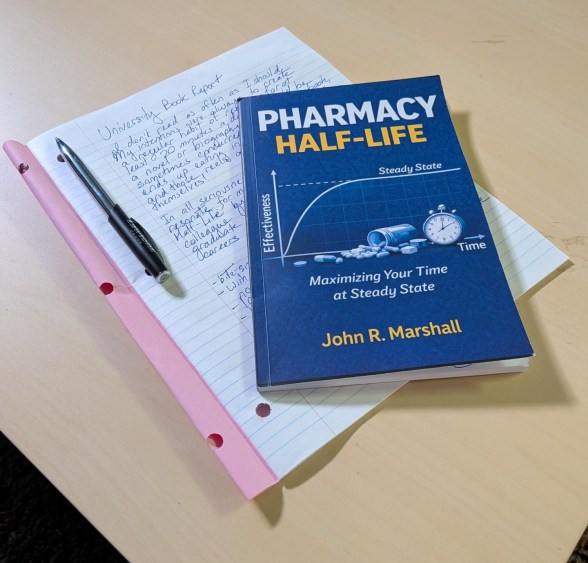
Ah, university…
My world of over a quarter-century ago. Back when adulting was new. The uncertainty and angst of a promising career delicately balanced with muted excitement for seemingly limitless opportunities! The late nights (for study of course 😉 and emerging social connections that have persisted to this day. Memories of notable professors and student personalities could fill up pages like a yearbook time capsule. Did I mention the procrastination?! Oh my yes, the wasted time we spent… Before the TikTok days, I was a beast for housework, but only when I had a big lab assignment due. Midterm exam tomorrow? What a lovely time to re-watch the Sixth Sense and hunt all the spoiler moments I missed the first time through.
That’s why I’ve titled this piece as a call-back to the days absorbing information through text was a full-time job. I was always better with conventional didactic learning as opposed to self-taught facts and concepts. Audio and visual cues were essential in my ability to recall and react to questioning. However, as I age my appreciation for the written word has deepened. Being able to peer between the lines to infer and incorporate lessons into my own experiences is a skill developed with experience and a reflective curiosity.
In truth, rarely has a book resonated with me as much as Pharmacy Half-Life – Maximizing Your Time at Steady State, written by a cherished friend and colleague, JohnR Marshall.
The messaging is familiar because the man is familiar. Our careers have plenty of parallels, from our education, our relationships and our career ambitions. He is passionate about life: his family comes first, followed by a insatiable drive to empower people through coaching in sports as well as his extensive pharmacy work. Reading Half-Life was akin to sitting across from him, feeling the warmth from a fire crackling in the hearth, and receiving one of the many spirited pep-talks he could deliver off-the-cuff. Even hearing his voice in my head as I flipped through the pages, there was something different…something more thought-provoking than usual.
The book itself is a very approachable read. There are 10 chapters of individual topics, each only about 3-4 pages in length, perfect for bite-sized chunks of wisdom. Each begins by offering a famous quote or example accompanied by personal anecdotes describing his journey of discovering how to thrive in the pharmacy profession. At the end of each chapter, there is a quick summary entitled ‘Positive Impacts’ that leaves the reader with a probing question. I found myself pausing between chapters to think about my own life and career.
My favourite chapters are 5) Leadership vs Management, and 8) Where Sport and Pharmacy Collide: Your Ideal Performance Mindset (IPM). The former explores key differences between organizational roles that are often seen as synonymous, when in fact there may be stark differences upon assessing cultural vs administrative functions. The latter introduces the reader to the concept of identifying their thought-process when performing at their absolute best, and nurturing behaviours to maintain that mindset in the face of external factors.
The prose is conversational, and comes from a vulnerable place; the author has lived within the pharmacy sphere for 25+ years and has gleaned valuable insight on how an individual can seek their own job satisfaction.
These are lessons I wish I’d known back in those university days. I would be fascinated to hear feedback from pharmacy students ready to make their mark on the profession. Very early on their journeys, have them think about leadership and how it can shape their careers:
- How to develop the traits of a leader and to nurture those traits in others.
- How to seek out and help build strong teams.
- Using the Ideal Performance Mindset to avoid negative spirals.
- How to be a good support, boss, peer and teammate
- Reinforcing WHY they chose pharmacy
Make no mistake, there are nuggets that may apply to any person at any stage of their professional life. In fact, many of the concepts are certainly not just reserved for pharmacy at all.
In conclusion, I suggest picking up your copy today, either as an electronic or paperback version. I keep mine on my desk as a reminder of where I’ve been and where I still want to go. Pharmacy has given me so much in terms of opportunities to grow and network, but finding that steady-state has not always been easy. Balancing work and family can often feel like you’re following a GPS that is constantly recalculating, taking you in many directions at once. Sometimes all it takes are the words of a trusted friend and mentor to keep your inner compass from spinning when life decides to shake the table.
I’m honoured to call JohnR such a friend. I’m proud that he decided to share his wisdom in an effort to help others.
Lastly, I hope my report deserves a good grade!
Disclaimer: The views and opinions expressed in this article are those of the author(s) and do not necessarily reflect the official policy or position of any agency, employer or affiliation.

