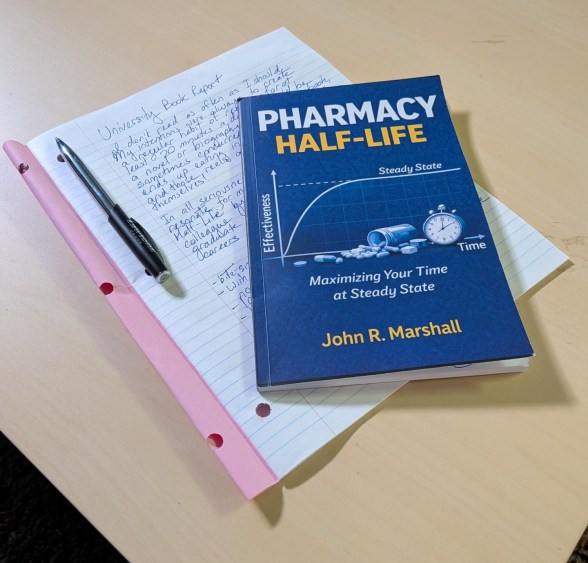
University Book Report – Pharmacy Half-Life

Ah, university…

My world of over a quarter-century ago. Back when adulting was new. The uncertainty and angst of a promising career delicately balanced with muted excitement for seemingly limitless opportunities! The late nights (for study of course 😉 and emerging social connections that have persisted to this day. Memories of notable professors and student personalities could fill up pages like a yearbook time capsule. Did I mention the procrastination?! Oh my yes, the wasted time we spent… Before the TikTok days, I was a beast for housework, but only when I had a big lab assignment due. Midterm exam tomorrow? What a lovely time to re-watch the Sixth Sense and hunt all the spoiler moments I missed the first time through.

That’s why I’ve titled this piece as a call-back to the days absorbing information through text was a full-time job. I was always better with conventional didactic learning as opposed to self-taught facts and concepts. Audio and visual cues were essential in my ability to recall and react to questioning. However, as I age my appreciation for the written word has deepened. Being able to peer between the lines to infer and incorporate lessons into my own experiences is a skill developed with experience and a reflective curiosity.

The messaging is familiar because the man is familiar. Our careers have plenty of parallels, from our education, our relationships and our career ambitions. He is passionate about life: his family comes first, followed by a insatiable drive to empower people through coaching in sports as well as his extensive pharmacy work. Reading Half-Life was akin to sitting across from him, feeling the warmth from a fire crackling in the hearth, and receiving one of the many spirited pep-talks he could deliver off-the-cuff. Even hearing his voice in my head as I flipped through the pages, there was something different…something more thought-provoking than usual.

The book itself is a very approachable read. There are 10 chapters of individual topics, each only about 3-4 pages in length, perfect for bite-sized chunks of wisdom. Each begins by offering a famous quote or example accompanied by personal anecdotes describing his journey of discovering how to thrive in the pharmacy profession. At the end of each chapter, there is a quick summary entitled ‘Positive Impacts’ that leaves the reader with a probing question. I found myself pausing between chapters to think about my own life and career.

My favourite chapters are 5) Leadership vs Management, and 8) Where Sport and Pharmacy Collide: Your Ideal Performance Mindset (IPM). The former explores key differences between organizational roles that are often seen as synonymous, when in fact there may be stark differences upon assessing cultural vs administrative functions. The latter introduces the reader to the concept of identifying their thought-process when performing at their absolute best, and nurturing behaviours to maintain that mindset in the face of external factors.

The prose is conversational, and comes from a vulnerable place; the author has lived within the pharmacy sphere for 25+ years and has gleaned valuable insight on how an individual can seek their own job satisfaction.

These are lessons I wish I’d known back in those university days. I would be fascinated to hear feedback from pharmacy students ready to make their mark on the profession. Very early on their journeys, have them think about leadership and how it can shape their careers:

  • How to develop the traits of a leader and to nurture those traits in others.
  • How to seek out and help build strong teams.
  • Using the Ideal Performance Mindset to avoid negative spirals.
  • How to be a good support, boss, peer and teammate
  • Reinforcing WHY they chose pharmacy

Make no mistake, there are nuggets that may apply to any person at any stage of their professional life. In fact, many of the concepts are certainly not just reserved for pharmacy at all.

In conclusion, I suggest picking up your copy today, either as an electronic or paperback version. I keep mine on my desk as a reminder of where I’ve been and where I still want to go. Pharmacy has given me so much in terms of opportunities to grow and network, but finding that steady-state has not always been easy. Balancing work and family can often feel like you’re following a GPS that is constantly recalculating, taking you in many directions at once. Sometimes all it takes are the words of a trusted friend and mentor to keep your inner compass from spinning when life decides to shake the table.

I’m honoured to call JohnR such a friend. I’m proud that he decided to share his wisdom in an effort to help others.

Lastly, I hope my report deserves a good grade!

Disclaimer: The views and opinions expressed in this article are those of the author(s) and do not necessarily reflect the official policy or position of any agency, employer or affiliation.

Letter To Me

Dear Devin,

The year is 1998. It’s December, and we have just learned that we failed the physiology final midway through second year. We are despondent and openly wonder if pharmacy is the right fit as a career.

Mom and Dad tried to guide us in high school; there was no plan for university other than wanting to stay in a science-related field. Mom’s background is child-development, so she always seemed to know what her kids would do or experience before we did. Dad’s training was in the fields of architecture and environmental design, requiring spatial orientation and extreme precision. Neither knew much about pharmacy other than they had a pleasant family pharmacist and were impressed by his combination of social skills and pharmacology knowledge. Sounded like it could be a viable option.

After 2 years of a chemistry degree, acceptance into the pharmacy program was an enormous source of pride. Eager to learn about a different kind of chemistry, there was another wrinkle to consider: the advent of problem-based learning (PBL). This style of learning is quite self-directed with minimal didactic lectures. Relying on peers to help educate and problem-solve was a dramatic departure from previous university experience. Accreditation for this new program was conditional, so that added to the nerves. As an aural/visual learner, frustrations began to mount with the lack of direction. Building a house without a foundation and having to craft all the pieces from scratch was proving to be a tall order.

Rest assured, we ARE on the right track. Waiting to re-write the exam at the end of the academic year was a struggle, but you’ll earn your pass and shall soon forget how close you came to moving in a different direction.

Pharmacy has been THE perfect fit for you and your personality. The highlights are numerous, but I shall attempt to preview a few of them:

  1. Benefits of Problem-Based Learning – Stay with me here. The method that almost broke our spirit ended up providing valuable tools for your journey. We will earn the ability to work collaboratively as a clinician, vetting good evidence from the poor, and learning how to own therapeutic decisions.
  2. The pharmacy community – From our time in class or tutorial, to our clinical rotations, to our first solo shift behind the counter, to our first medication error, there will be a sense of belonging from countless professors, preceptors, mentors and confidants along the way. As an older and wiser you, I am excited to say that many of your classmates still hold special places in your life 25 years later.
  3. A wealth of opportunity – This doesn’t just refer to roles of employment with escalating responsibility. It also includes contributions to continuing education, advisory/steering committees, regulatory projects, advocacy events with government representatives, and the chance to specialize in special populations or disease states.
  4. Continuing Care – This segment of pharmacy will prove to be one of the most rewarding in our career, both as a facility consultant and later as an operations manager. Working with the frail elderly will provide a rich appreciation of the delicate balance between therapeutic outcomes and quality of life.
  5. Coaching – Watching people grow their skills and thrive along their chosen paths will become our main fount of purpose, streaming with pride. You never know when someone you introduce to the profession of pharmacy will choose it as their own career path.

In addition, there will be a few items that with the benefit of hindsight, are now a source of amusement:

  1. Carbon Paper – It shouldn’t come as any surprise that dot matrix printer ribbons were past their prime from the time we accepted that first pharmacy job. Filling out manual claims on carbon copies and mailing them to insurance plans will seem ridiculous almost immediately. Enjoy the ‘zip-zip’ sounds and the tearing of those perforated strips while you can.
  2. Sleuthing – On occasion we might feel like a big deal when reading a prescription with terrible handwriting for a drug name that hasn’t existed in two decades from an out-of-town doctor who graduated med school in the sixties. It may impress the new interns, but we have to acknowledge just how terribly unsafe many of those orders will be.
  3. Compounding – Taking out the hotplate and magnetic stirrer to melt some soft paraffin is surprisingly satisfying, that is until the the cap is removed from the bottle of LCD that remains to be added. That dark brown liquid with an unmistakable scent lingered like no other. It managed to stain everything and seemed to splash by itself no matter how careful we tried to be. Take home point: always take advantage of our yearly quota of lab-coat purchases!
  4. Errors happen – The goal of perfection is noble, but impossible. Enter each day with the mindset to help as many people as you can safely and conscientiously. We will own our mistakes and do our best to learn from them. Do not allow a singular negative patient experience to detract from hundreds and thousands of positive interactions. Our intention is to help people, and we certainly will.

To sum up, please stick with this gift of a career and keep an open mind about what kind of pharmacist…check that…person you want to be. Be thankful for the journey and the people that make it meaningful. Use your lessons to inspire others to grow within the profession. Stay curious. Stay grounded. We may never fully appreciate the impact we will have but down the road a little ways, those fingerprints will be recognizable.

Can’t wait for you to venture out into young adulthood and make some marks! Best of luck on our chosen path.

Sincerely,

You/Me #stillaworkinprogress

PS – Hashtags (#) will make more sense in about 10-15 years 😉

Disclaimer: The views and opinions expressed in this article are those of the author(s) and do not necessarily reflect the official policy or position of any agency, employer or affiliation.

Team Dynamics – Greater Than The Sum of its Parts

It’s no great secret that if given the option, individuals would prefer to be in control of their current situation, their short-term goals and long-term dreams. You’ve no doubt heard that sitting and waiting for opportunity to come along doesn’t usually end up as expected. It may knock once and awhile, and being prepared to answer that door takes commitment and a tenacious attitude. So what if the opportunity presented means being an integral part of a strong team?

A very close friend of mine has been in various leadership roles for well over a decade. He recently sent a message to his teams opining that some of his strongest teams did not always comprise of his strongest individual performers. I hesitate to use the word chemistry due to buzzword cliches, but we’re in the world of pharmacy so the subject shouldn’t be completely foreign. A mixture of complementing skills are necessary. Some people are excellent at rote tasks; they are consistent with details and process. Others have excellent customer-service skills and some may be solid project managers. If someone was behind on the prescription assembly counter due to an extended customer interaction, then another would recognize and backfill to prevent a bottleneck (and therefore a future, more negative customer interaction). A pharmacist manager working on staff reviews jumps out of the office to perform a flu shot because her staff is out of the dispensary for an OTC counsel. It takes a certain level of awareness and good chemistry to adapt depending on the circumstances.

The strongest teams seem to grow into that adaptive mentality and it never happens overnight. Routines are developed (e.g. mixing methadone batches on Wednesday afternoons), and trends are identified (e.g. many people pick up prescription orders on Thursdays over the supper hour). Folks begin to understand non-verbal cues or body language from their colleagues that betray a rising sense of anxiety, such as a deep-breath after a series of interruptions, or a rash of careless mistakes to suggest rushing.

I should point out that complementing skills doesn’t just mean balancing relative weaknesses, it’s also about enhancing inherent strengths within the team. That’s why the saying goes, “the result is greater than the sum of its parts.” So why does a team of strong performers not always share a strong level of success? This phenomenon happens in sports all the time; a dream team is bought or drafted and grossly underwhelms, looking disconnected and listless in the process.

There are a few different theories as to why this occurs. One is a measure of ego; a strong performer is used to having a degree of autonomy in their job, and has a specific way to complete tasks. The trust that another may be able to meet the same standard can take time to develop. In a competitive environment, the strong performer has an incentive to use these tasks to display their own skills and may feel a threat to their autonomy if another meets or exceeds the same standards.

In a similar vein, strong performers often have take charge attitudes. For team production, some of those folks need to be comfortable supervising, and others will need to follow. If there is no deference from anyone, it begins to feel like ‘too many cooks in the kitchen’. Everyone has their own plan but it may conflict with another. The whole point of being proactive is to plan ahead and avoid potential conflict, that’s why big-picture thinking is so important at the outset of any project.

As a manager myself, I certainly derive my work satisfaction from watching others being proactive and working together. They identify problems before they present, and take steps to always be ahead of any change on the wind. Those qualities can serve as fuel because there always has to be a new challenge, or a variety of tasks to master. I need to stay proactive to keep the team growing and motivated. The leaders I respect and look to for guidance all seem to do the same. We make each other better, and we find ways to reach heights we could never have imagined on our own.

Is your team ready to answer the door?


Disclaimer: The views and opinions expressed in this article are those of the author(s) and do not necessarily reflect the official policy or position of any agency, employer or affiliation.

The Quest for Job Satisfaction – Choose Your Own Adventure

What does job satisfaction mean to you?

-Really-

Have you ever thought about it? Is it the wage you earn or the vacation you accrue? Is it winning arguments with colleagues or landing that huge business opportunity? Is it directing a team or nurturing individuals in their roles? Are you proud of work accomplishments?  Is it the value you provide to the operation/team/public?

Is it all of the above?

True job satisfaction doesn’t seem to follow a formula or template. If it does, I certainly have been looking in the wrong places. My personal adage is simple and goes something like this:

Job satisfaction is not something that anyone can give to you, be it the boss, your colleagues, or your friends. You have to want it, you have to recognize what adds to (or subtracts from) it, and most importantly, you have to feel it.

The quest part represents the fact that we never stop growing, and therefore the source of your personal job satisfaction may evolve over time. Tasks or responsibilities that were once daunting start becoming less of a challenge. The environment you’re in may shift and offer new and exciting opportunities of which you may want to take advantage.

The new pharmacy landscape will offer plenty of potential niches to fill, ledges to reach for, wide open spaces to explore, and peaks to ultimately summit. This quest, should you choose to accept it, requires an open mind and an awareness of current personal or logistical limitations, as they may impact the first direction you choose to go. You may also need a few things:

1) Mentors – folks you look up to and make you think. It’s in their nature to push you places you may not go otherwise.

2) Leaders – Provide a vision for where pharmacy is going. Well-respected in the community and among their peers, they motivate and set the tone for how we may approach perceived barriers (i.e. – public acceptance of pharmacists providing flu shots).

3) Supporters – Colleagues, peers, friends, family. This network forms the glue that keeps your aspirations focused and achievable.  If you need a boost, they’re right behind you and really mitigate the negative slides.

4) Resources – Could be people, but more often it is information. Ask questions, read whatever interests you. Whether it’s renal failure or cancer research, mental health or menopause, stoking those passions will provide insight into what really gets you out of bed in the morning.

So choose your own adventure. Just like the book series, take it a day at a time and when you have a choice to make, be convicted and accept the consequences on the random page you end up flipping to. I for one am looking forward to exploring all the possible endings. Are you?