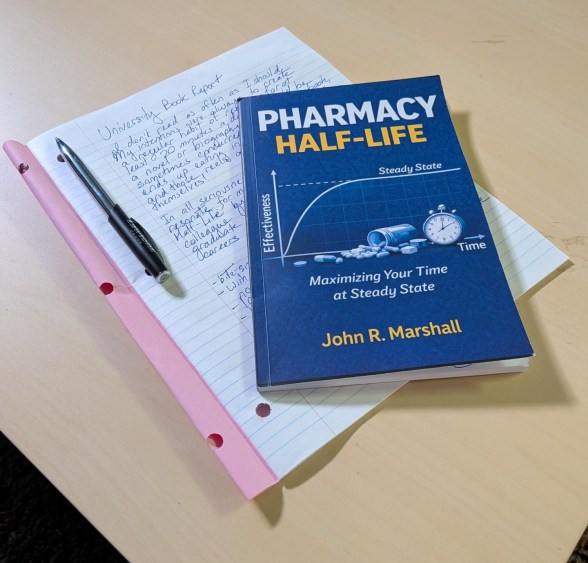
University Book Report – Pharmacy Half-Life

Ah, university…

My world of over a quarter-century ago. Back when adulting was new. The uncertainty and angst of a promising career delicately balanced with muted excitement for seemingly limitless opportunities! The late nights (for study of course 😉 and emerging social connections that have persisted to this day. Memories of notable professors and student personalities could fill up pages like a yearbook time capsule. Did I mention the procrastination?! Oh my yes, the wasted time we spent… Before the TikTok days, I was a beast for housework, but only when I had a big lab assignment due. Midterm exam tomorrow? What a lovely time to re-watch the Sixth Sense and hunt all the spoiler moments I missed the first time through.

That’s why I’ve titled this piece as a call-back to the days absorbing information through text was a full-time job. I was always better with conventional didactic learning as opposed to self-taught facts and concepts. Audio and visual cues were essential in my ability to recall and react to questioning. However, as I age my appreciation for the written word has deepened. Being able to peer between the lines to infer and incorporate lessons into my own experiences is a skill developed with experience and a reflective curiosity.

The messaging is familiar because the man is familiar. Our careers have plenty of parallels, from our education, our relationships and our career ambitions. He is passionate about life: his family comes first, followed by a insatiable drive to empower people through coaching in sports as well as his extensive pharmacy work. Reading Half-Life was akin to sitting across from him, feeling the warmth from a fire crackling in the hearth, and receiving one of the many spirited pep-talks he could deliver off-the-cuff. Even hearing his voice in my head as I flipped through the pages, there was something different…something more thought-provoking than usual.

The book itself is a very approachable read. There are 10 chapters of individual topics, each only about 3-4 pages in length, perfect for bite-sized chunks of wisdom. Each begins by offering a famous quote or example accompanied by personal anecdotes describing his journey of discovering how to thrive in the pharmacy profession. At the end of each chapter, there is a quick summary entitled ‘Positive Impacts’ that leaves the reader with a probing question. I found myself pausing between chapters to think about my own life and career.

My favourite chapters are 5) Leadership vs Management, and 8) Where Sport and Pharmacy Collide: Your Ideal Performance Mindset (IPM). The former explores key differences between organizational roles that are often seen as synonymous, when in fact there may be stark differences upon assessing cultural vs administrative functions. The latter introduces the reader to the concept of identifying their thought-process when performing at their absolute best, and nurturing behaviours to maintain that mindset in the face of external factors.

The prose is conversational, and comes from a vulnerable place; the author has lived within the pharmacy sphere for 25+ years and has gleaned valuable insight on how an individual can seek their own job satisfaction.

These are lessons I wish I’d known back in those university days. I would be fascinated to hear feedback from pharmacy students ready to make their mark on the profession. Very early on their journeys, have them think about leadership and how it can shape their careers:

  • How to develop the traits of a leader and to nurture those traits in others.
  • How to seek out and help build strong teams.
  • Using the Ideal Performance Mindset to avoid negative spirals.
  • How to be a good support, boss, peer and teammate
  • Reinforcing WHY they chose pharmacy

Make no mistake, there are nuggets that may apply to any person at any stage of their professional life. In fact, many of the concepts are certainly not just reserved for pharmacy at all.

In conclusion, I suggest picking up your copy today, either as an electronic or paperback version. I keep mine on my desk as a reminder of where I’ve been and where I still want to go. Pharmacy has given me so much in terms of opportunities to grow and network, but finding that steady-state has not always been easy. Balancing work and family can often feel like you’re following a GPS that is constantly recalculating, taking you in many directions at once. Sometimes all it takes are the words of a trusted friend and mentor to keep your inner compass from spinning when life decides to shake the table.

I’m honoured to call JohnR such a friend. I’m proud that he decided to share his wisdom in an effort to help others.

Lastly, I hope my report deserves a good grade!

Disclaimer: The views and opinions expressed in this article are those of the author(s) and do not necessarily reflect the official policy or position of any agency, employer or affiliation.

The Term Accessibility: It’s Gaining a Double-Edge

It was a hot sunny Thursday in July and I’m finally starting to feel a bit better. The previous two weeks were a collection of progressive symptoms from dry cough, then wet cough, then sinus block, then pain in the diaphragm, culminating in a wheezy mess with some shortness of breath mixed in. I’ll save the vibrant descriptions of the sights and sounds emanating from my lungs, but let’s just say that both my condition and demeanor were quite phlegmatic.

I was just recently contacted for a new family practitioner. My former physician retired in November of 2022 and the waitlist finally reached my name. Unfortunately the intake appointment was not for another three weeks, so the next Monday I decided to research booking an appointment at a local after-hours medical clinic. Looking at the government website, it listed nine locations in the province. In checking the hours of each, I discovered that only ONE (1!) had hours listed for the day, but it was an evening clinic from 5-9pm, located over an hour away, AND you had to pre-book an appointment. A pharmacist-led walk-in clinic no doubt would have resulted in a referral, so I decided to hit the nearby hospital emergency department.

I’m very fortunate to not have been in need of any medical intervention during these past few years. As such, navigating the current system as a patient was foreign to me. With all of the changes introduced throughout the pandemic, and a severe shortage of family practitioners, I was unsure of whether my situation warranted a spot on the emergency department triage list.

I rolled the dice and parked in the 4-hour parking lot, hoping it’d be enough time to at least get through the preliminary assessment. Hearing horror stories of 9-hour waits meant I’d be moving my car at some point. There were three steps: 1) Triage, 2) Registration, and 3) Wait for your name to be called. The first two were fairly quick, within 45 minutes, and I settled in for a lengthier stay. At this point of the morning, the monitor hanging above the department conveyed there were 25 others sharing the waiting room, with an additional 73 patients already within the unit. There were plenty of people in and out of the doors, but my perception was that there were very few in visible distress. It did appear that like me, many were orphan patients that needed attention or follow-up for chronic conditions, and had very few options other than wait their turn.

I received an ECG (requiring a wee bit of shaving) and chest x-ray before receiving a diagnosis of atypical pneumonia and a couple of prescriptions. The whole process took about 3 hours and 45 minutes. When I got back to the car my thought was that I made out like a bandit. I may have been classified as a 3 – Urgent on the Canadian Triage and Acuity Scale but to be in and out under four hours? I had plenty of time to drop off my orders at the pharmacy for filling and be home in time for supper.

Then it occurred to me…

Why don’t pharmacy practitioners enjoy a similar grace? Why is the on-demand nature of pharmacy services becoming such a flashpoint for patients and practitioners alike? With burnout reaching a fever pitch, methods for protecting pharmacy staff should include mechanisms that give a similar control over triage and capacity to address patient needs. Inevitably, this has led to sombre reflection on one of the singular tenets of pharmacy practice for as long as I can remember: accessibility.

The pharmacy profession has long touted accessibility as a calling card. For decades it was understood that pharmacists were relatively underutilized; as drug experts, there was significant education provided towards pathophysiology, medicinal chemistry, pharmacology, and evidence-based disease state management. Although diagnostics were not a focus, inter-professional collaborative practice allowed for plenty of exposure to assessment and documentation. Pharmacists achieved a degree of comfort with many common self-limiting ailments and the savvy to make strong referrals for medical interventions beyond their scope. The public were initially wary, and advocates really pushed for pharmacy to shoulder more of a primary healthcare burden.

When the pandemic hit and services became increasingly scarce, once again pharmacy professionals did their best to position themselves as a trusted point of contact for patients in need. Whether it be a long-time patient needing renewals on their diabetes medications, or an orphan patient with uncontrolled hypertension needing an adjustment in therapy, pharmacy staff did their absolute best to intervene and monitor those conditions.

In fact, they were so successful in delivering that care, the public quickly recognized the value and convenience, which began to affect conventional dispensary workflow. Investing and dedicating staff to provide these clinical services has come with a new suite of challenges, with two of the major ones being 1) the transition from a ‘walk-in’ to an appointment-based practice, and 2) inconsistent / confounding funding models for service provision. Yes, pharmacists are legally permitted to perform a range of prescribing activities, however many are subject to conditions or restricted to specific scenarios to be eligible for coverage. Depending on your province or jurisdiction, the management of clinical problems may differ somewhat.

A current example is the recent statement from the Government of Canada regarding the shortage of combination pain-relievers containing codeine and oxycodone. Due to a manufacturing disruption, these products are in short supply for the next few months. As acute pain relievers, these medications are used as part of recovery regimens for minor dental and surgical procedures, as well as critical options for breakthrough relief for many patients with chronic pain syndromes. On the front lines, pharmacists are feeling the brunt of this problem; patients are upset and nervous that their therapies will be disrupted. Potential solutions could include therapeutic substitutions and prescription adaptations within a pharmacist’s scope, and in many cases those services are now expected. At issue is the underfunded time spent to provide these services, which make it exceedingly difficult to plan ahead and increase capacity within existing pharmacy practices without taking substantive risks.

So the question remains: how does the profession stay accessible whilst controlling that same accessibility? Although I am apprehensive of the idea of using a weapon to illustrate a concept, it stands to reason that there is inherent danger in how the issue is handled. If this accessibility ‘sword’ isn’t properly balanced, it could risk bringing harm to the patients (less access to timely services) or to the practitioners seeking to provide quality care (more access but without proper supports). It’s delicate, but we’re well on the way to finding the new sweet spot.

It will take practice and discipline, but we are more than up to the challenge. Of course, changing behaviors and perceptions is a huge undertaking, however the pharmacy community has proven itself to be incredibly resourceful and resilient. We will continue to lean on each other as we grow as clinicians. I strongly believe the solutions we need are all here within the community. In a future post we shall endeavour to review some strategies and generate even more discussion.

Make no mistake, in a short time, we will become proficient in wielding this accessibility sword and achieve that proper balance. The healthcare system will benefit, the pharmacy teams will benefit, and the public will benefit most of all.

Disclaimer: The views and opinions expressed in this article are those of the author(s) and do not necessarily reflect the official policy or position of any agency, employer or affiliation.